Article: The Science Behind Midori Repair Balm: Why Your Skin Deserves Better Than Basic Moisture.
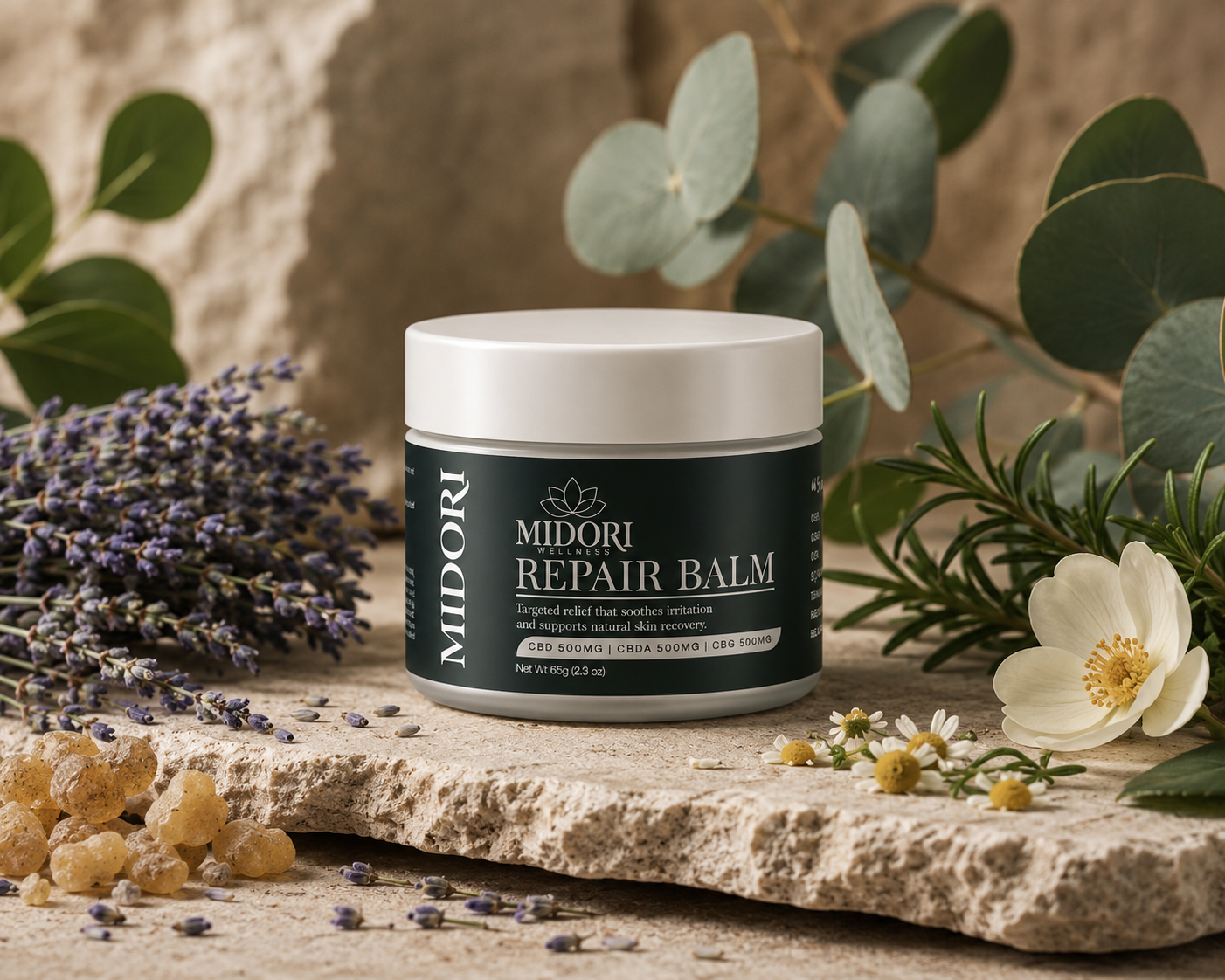
The Science Behind Midori Repair Balm: Why Your Skin Deserves Better Than Basic Moisture.
Your skin is doing something remarkable right now. It's blocking pathogens, regulating temperature, retaining water, and signaling the immune system — all at the same time. When that delicate system becomes stressed, whether from dryness, sensitivity, seasonal shifts, or the demands of tattooed skin, it doesn't just need moisture. It needs a comprehensive, intelligent response.
That's exactly what Midori Repair Balm was formulated to deliver.
This isn't a quick-fix moisturizer. It's a concentrated, multi-ingredient botanical formula built around one core principle: support your skin's own biology so it can do what it does best. Every ingredient was chosen for a reason, and together, they form a synergistic system that works far beyond surface hydration.
What "Skin Barrier Support" Actually Means
The phrase gets used a lot in skincare, but it carries real biological weight. Your skin barrier — technically the stratum corneum — is a layered structure of dead skin cells held together by lipids (fats). When it's healthy, it locks moisture in and keeps irritants out. When it's compromised, water escapes, allergens penetrate more easily, and skin becomes reactive, dry, and visibly stressed.
Barrier damage is behind most of the skin complaints that customers come to us with: chronic dryness, redness-prone skin, flaking, and sensitivity that seems to flare unpredictably. For tattooed skin, barrier integrity is especially important — it's what keeps ink looking vivid and the surrounding skin smooth.
Midori Repair Balm approaches barrier support from multiple angles simultaneously. That's what separates a true repair formula from a standard lotion.
The Foundation: Oils and Waxes That Lock and Nourish
Before botanical extracts can do their work, the skin needs a protective, moisture-retaining base. Midori Repair Balm leads with coconut oil, squalane, and beeswax — a trio chosen for complementary functions.
Squalane is structurally similar to the oils your skin naturally produces, which means it absorbs efficiently without clogging pores or leaving residue. According to CeraVe's ingredient research, squalane helps reduce moisture loss, smooth rough texture, and support overall barrier function — making it particularly well-suited for dry, eczema-prone, and sensitive skin types. Colorescience notes that its antioxidant properties also help protect the skin barrier from oxidative stress caused by environmental exposure.
Beeswax acts as a physical seal — creating a breathable layer on the skin's surface that slows transepidermal water loss (TEWL) without suffocating the skin. The result is a balm that feels rich upon application but settles into a comfortable, non-greasy finish.
The Botanical Trio: Arnica, Comfrey & Calendula
These three herbs have been used in traditional skin care for centuries, and modern research continues to validate their effectiveness.
Arnica is perhaps the most recognized, with a long history of use for skin that appears swollen, irritated, or discolored. Comfrey contains allantoin — a compound well documented for its ability to support the skin's natural renewal process and contribute to a smoother-looking appearance. Calendula is naturally anti-inflammatory and has long been used to calm irritated or inflamed skin, making it a cornerstone of sensitive-skin formulation.
Together, these botanicals bring soothing, skin-normalizing energy to the formula. For skin that's been through it — whether from weather, physical activity, or daily stress — this trio provides visible comfort.
Tamanu Oil & Turmeric: Antioxidant Power
Two of the most scientifically compelling ingredients in Midori Repair Balm are tamanu oil and turmeric extract.
Tamanu oil is a fatty botanical oil with a remarkably broad profile of skin-supportive properties: it's antibacterial, anti-inflammatory, and has been studied for its role in supporting the skin's natural renewal process and contributing to a smoother-looking appearance over time. According to Meadow and Bark's research overview, tamanu's bioactive molecules work at a cellular level — a depth of action rarely found in plant-based oils. For skin that's been compromised by dryness, reactivity, or tattooing, tamanu oil is a powerful restorative ally.
Turmeric extract brings its signature antioxidant curcuminoids into the formula, which work to reduce oxidative stress, support skin tone, and complement the anti-inflammatory activity of the surrounding botanicals. If you've read our Deep Relief Crème post, you already know how important turmeric is across the Midori lineup — it's not just a trend ingredient here; it's a foundational one.
Calming Oils: Helichrysum, Chamomile & Lavender
Redness and reactive skin have a botanical answer in this three-oil combination.
Helichrysum — sometimes called the "everlasting flower" — has a standout reputation in natural skincare. Research published in the International Journal of Molecular Sciences confirmed that helichrysum extract stimulates collagen production and can accelerate epithelization (the process of new skin forming over damaged tissue). Toups and Co Organics notes that it's especially prized for its ability to reduce the appearance of redness and strengthen the barrier against future disruption — making it ideal for skin that appears reactive or easily irritated. Healthline also highlights its evidence-based anti-inflammatory and antimicrobial properties, with early research suggesting benefits for contact dermatitis and wound healing.
Chamomile essential oil contains bisabolol and apigenin — compounds studied for their gentle skin-calming properties. It rounds out the formula's approach to visible redness without the harshness of synthetic actives.
Lavender oil needs little introduction. Beyond its well-loved aroma, lavender brings additional calming, antimicrobial properties to the balm. Its inclusion also enhances the overall sensory experience of application — an often underrated factor in how well a product integrates into a daily routine.
The Cannabinoid Complex: CBD, CBG & CBDA
Midori Repair Balm includes a full-spectrum cannabinoid component: CBD, CBG, and CBDA — each contributing distinct, complementary benefits to skin health.
CBD (cannabidiol) is now among the most studied topical ingredients in dermatology. A comprehensive review published in Biomolecules summarizes CBD's profile as including anti-inflammatory, antioxidant, and moisturizing properties. Research continues to explore CBD's interaction with the skin's endocannabinoid system (ECS) — a regulatory network that plays a key role in maintaining skin balance and hydration.
CBG (cannabigerol) is increasingly earning attention as a standalone skincare compound. According to Practical Dermatology, a clinical trial found that a 0.1% CBG serum significantly reduced inflammation and redness while improving skin barrier function — outperforming placebo. Additional research indicates that CBG is twice as effective as CBD at neutralizing free radicals, and also inhibits tyrosinase — the enzyme linked to hyperpigmentation — suggesting benefits for uneven skin tone alongside its anti-inflammatory action.
CBDA (cannabidiolic acid) is the raw, acidic precursor to CBD and retains distinct properties in its own right, contributing to the formula's overall cannabinoid synergy.
The combination of all three creates a layered botanical synergy — each cannabinoid contributing its own profile of skin-supportive properties. For skin that needs to restore balance, this cannabinoid complex is a meaningful differentiator.
Vitamins That Work at the Cellular Level
Nourishment doesn't stop at the surface. Midori Repair Balm delivers three essential skin vitamins directly where they're needed.
Vitamin B5 (panthenol) is a well-studied skin care workhorse. La Roche-Posay highlights its ability to comfort sensitive skin, reduce the appearance of redness, and support recovery — noting that it's commonly found in post-tattoo formulas for a reason. A clinical overview by Dr. Tanya Skincare explains that panthenol attracts and holds water in the skin while boosting lipid production to strengthen the barrier — two actions that directly address the core issues of dry, reactive, or compromised skin.
Vitamin E (tocopherol) is a lipid-soluble antioxidant that integrates into the skin's membranes, protecting cells from oxidative damage while supporting moisture retention. It works synergistically with many of the other ingredients in this formula.
Vitamin D plays an underappreciated role in skin resilience. Topically applied, it supports the skin's immune regulation and contributes to a healthier, more balanced-looking complexion.
Terpene Enhancers: Beta-Caryophyllene, Linalool & Myrcene
These aren't just flavor notes from the plant kingdom — they're bioactive compounds with real physiological effects.
Beta-caryophyllene is a naturally occurring terpene found in black pepper, cloves, and cannabis, valued for its calming botanical properties and its contribution to the formula's anti-inflammatory profile. Linalool, naturally occurring in lavender, amplifies the calming botanical character of the balm. Myrcene, found in hops and cannabis, contributes additional soothing properties that complement the overall skin-comfort goal of the formula.
Together, these terpenes enhance not just the aromatic experience but the functional depth of Midori Repair Balm — deepening the absorption and synergy of the full ingredient system.
A Note on Sensitive Skin Conditions
Many of our customers reach for Midori Repair Balm when managing skin prone to psoriasis, eczema, or rosacea. We formulate with those concerns in mind — and we're proud that so many people find real comfort in this balm as part of their daily care.
Midori Repair Balm is not a medical treatment and is not intended to diagnose, treat, or cure any skin condition. If you have a diagnosed condition, please consult a healthcare professional before incorporating new products.
How to Use Midori Repair Balm
Apply a small amount to clean, dry skin and allow it to absorb. The balm melts gently on contact with skin warmth, making it easy to work into rough patches, problem areas, or the full face and body.
For tattooed skin, apply once the skin has fully healed and is ready for moisturizing. Consistent daily use supports hydration, barrier integrity, and the long-term vibrancy of your ink.
For dry or sensitive skin, morning and evening application delivers the most consistent results.
The Midori Difference
Every ingredient in Midori Repair Balm was chosen because it contributes something specific — not for label appeal, but for measurable skin support. The synergy between cannabinoids, botanical extracts, restorative oils, and vitamins creates a formula that works on multiple layers simultaneously.
When your skin needs more than moisture, it needs Midori Repair Balm.
Sources
-
Squalane Oil: What Is It and How Does It Benefit Your Skin? — CeraVe
-
Benefits of Helichrysum Oil for Skin — Toups and Co Organics
-
Helichrysum Essential Oil: Benefits, Uses, and Precautions — Healthline
-
Cannabidiol in Skin Health: A Comprehensive Review — Biomolecules / PMC
-
Why CBG is the New Hero in Skincare Science — Emotion Master
-
Vitamin B5 for Skin: A True Skin Barrier Repair Saviour — Dr. Tanya Skincare
Want to learn more? Take a look at our other blog posts.
The Science Behind Midori Repair Balm: Why Your Skin Deserves Better Than Basic Moisture.
Cannabinoids in Skincare : What CBD, CBG, CBN & CBDA Actually Do
Why the Best Sleep of Your Life Starts With What Happens After You Fall Asleep
The Gold Standard of Skincare Ingredients: Why Manuka Honey UMF 16+ Changes Everything
Japanese Skincare Ingredients: The Ancient Botanicals Behind Midori's Body Oil Ritual.
On The Green CBD Is Now Midori Wellness — and the Formulas Have Never Been Better
World Cup 2026 CBD Soccer Recovery
Does CBD Show Up In A Drug Test
CBG vs CBD: What's the Difference and Why You Need Both?
The Botanical Science Behind Targeted Comfort: Why Midori Wellness Relief Crème Is Built Different