Article: CBD for Arthritis and Stiff Joints: How Every Ingredient in Relief Crème Was Chosen for a Reason

CBD for Arthritis and Stiff Joints: How Every Ingredient in Relief Crème Was Chosen for a Reason
Arthritis is not a rare condition. It affects roughly 1 in 5 U.S. adults, and by the CDC's own projections, that number is only climbing as the population ages. If you're one of the millions navigating stiff knees in the morning, achy hands after a day of typing or gardening, or joints that just don't move the way they used to, you've probably already looked into topical CBD. What you may not know is why a formula works the way it does or that a genuinely effective topical rarely comes down to one hero ingredient.
Midori's Relief Crème was built from eleven active botanicals and cannabinoids, each selected for a specific, researched role in supporting joints that feel stiff, overworked, or simply older than they used to be. This isn't a marketing gloss over a generic base cream. Below, we break down every active ingredient and what it is, what the published research says about it, and exactly how it contributes to the formula.
A note before we start: Relief Crème is a cosmetic wellness product, not a drug. It is not intended to diagnose, treat, cure, or prevent arthritis or any other disease, and nothing below should be read as a substitute for medical advice. What follows is a summary of publicly available ingredient research so you can make an informed decision, always talk to your doctor about how to manage a diagnosed joint condition.
Understanding Joint Stiffness and Arthritis
Arthritis is an umbrella term for more than 100 conditions that affect the joints and the tissue around them, with osteoarthritis the wear-and-tear breakdown of cartilage being the most common form, affecting more than 32 million U.S. adults. Morning stiffness, reduced range of motion, and joint sensitivity after activity are hallmark symptoms, and they're also exactly the sensations people are searching for solutions to when they type "CBD for arthritis" or "cream for stiff joints" into Google. This is the exact audience Relief Crème was formulated for, not as a medical treatment, but as a targeted, research-informed part of a daily routine that supports how joints feel and move.
The Cannabinoid Complex: CBD + CBG
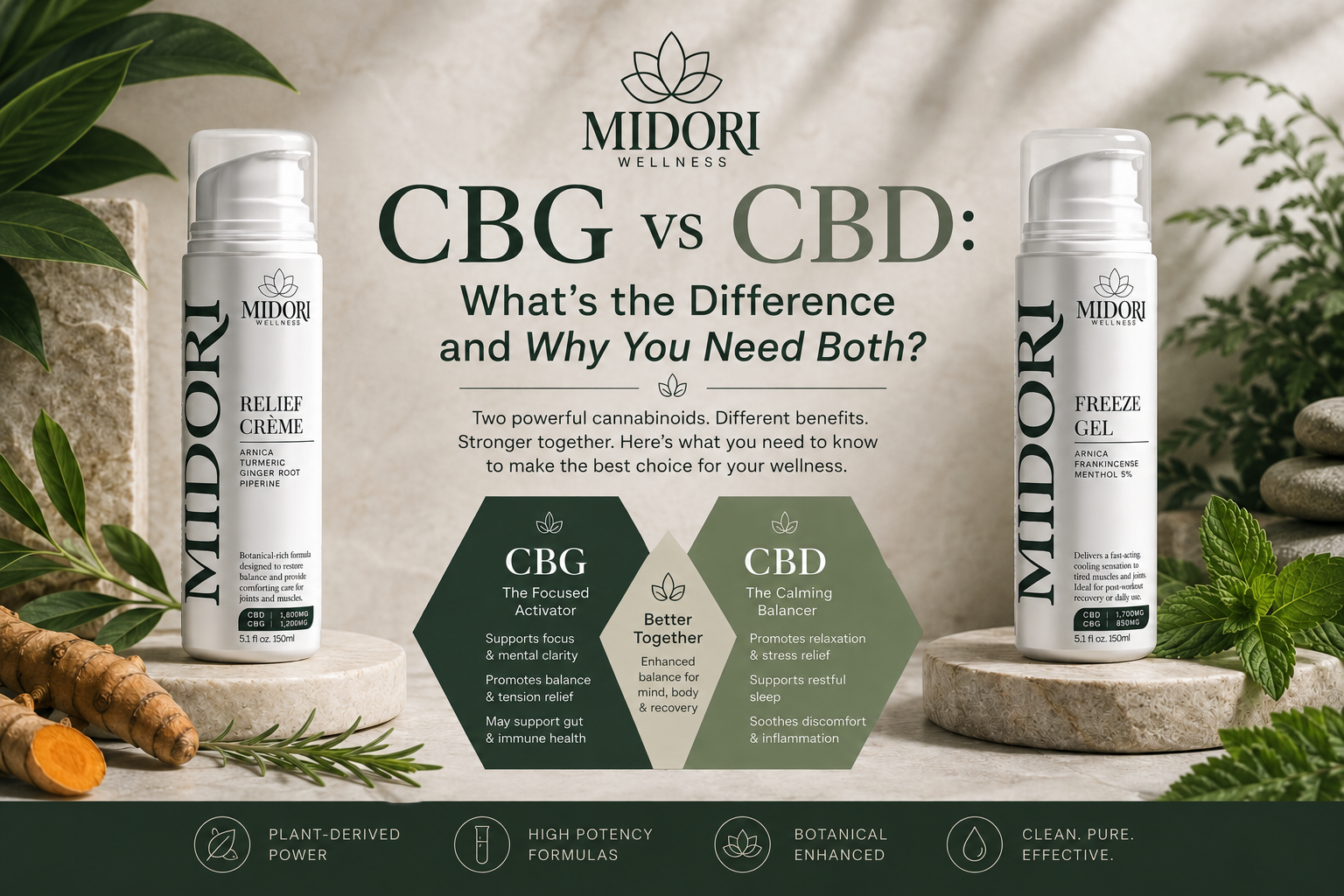
Relief Crème delivers 1,800mg of CBD and 1,200mg of CBG per 150ml pump 3,000mg of total cannabinoids in a single bottle. That ratio isn't arbitrary. Here's what each one brings to the formula.
CBD
CBD is the most extensively studied cannabinoid for joint-related use, and the research specific to arthritis has grown substantially in recent years. A 2022 randomized controlled trial published in the Journal of Hand Surgery tested topical CBD against a placebo in patients with thumb basal joint arthritis and found measurable improvements in patient-reported outcome scores in the CBD group. A separate cross-sectional study in PMC surveying arthritis patients using CBD found the majority reported improvements in physical function and daily activity. Preclinical research adds mechanistic support: a rat model study on transdermal CBD found topically applied CBD reduced joint swelling markers in an induced-arthritis model without notable side effects, and a 2023 study on topical CBD in individuals with chronic lower-extremity discomfort reported significant improvement in self-reported comfort scores over the study period. A broader 2022 review of CBD in rheumatic disease summarizes the current state of the science: promising, mechanistically plausible, and an active area of ongoing clinical study.
In Relief Crème, CBD is the foundation of the formula's calming sensory profile, the ingredient most responsible for that settled, comfortable feeling on skin after application.
CBG
CBG is a newer addition to joint-focused research, but the early data is compelling. A 2026 study on CBG's effect on immune cell activity found that CBG reduced pro-inflammatory cytokine secretion from human neutrophils in a dose-dependent manner and, in a mouse model of rheumatoid arthritis, reduced immune cell recruitment to inflamed joints. The study's authors are careful to note these are preclinical findings that require further validation before any therapeutic claims can be made but the mechanistic signal is notable enough that CBG researchers are actively pursuing it. Separately, a comprehensive 2024 review of CBG's biological activity documents its wide-ranging interest across inflammation, antioxidant activity, and skin health research.
Where CBD engages the endocannabinoid system indirectly, CBG binds more directly to CB1 and CB2 receptors, which is why formulating with both, rather than either alone, is a deliberate layering decision rather than redundancy.
The Botanical Actives: Arnica, Turmeric, Ginger, and Black Pepper
Arnica Montana Flower Extract
Arnica has one of the longest histories of any ingredient in this formula, it's been used topically in European herbal medicine for centuries specifically for sore joints and muscles, and it's also one of the better-studied botanicals for this exact use case. A Cochrane-affiliated review of topical herbal therapies for osteoarthritis found that in a trial of 174 people with hand osteoarthritis, arnica gel produced comfort outcomes comparable to ibuprofen gel, with a similar rate of mild adverse events. A separate open multicenter trial of Arnica montana gel in knee osteoarthritis found significant improvements on the WOMAC index, a standard measurement of joint stiffness, function, and comfort, across an intention-to-treat population of nearly 80 participants, with the majority rating the gel favorably for tolerability.
In Relief Crème, arnica is the ingredient most directly tied to that traditional "muscle and joint rub" sensory category, the reason the formula feels purposeful rather than like a generic moisturizer.
Curcuma Longa (Turmeric) Root Extract
Turmeric's active compound, curcumin, is one of the most heavily researched natural compounds for joint comfort in the world. A 2021 systematic review in BMJ Open Sport & Exercise Medicine analyzed ten separate studies on turmeric and curcumin for knee osteoarthritis and found consistent improvement from baseline across all of them, with three studies showing outcomes comparable to NSAID medications. A systematic review and meta-analysis in the Journal of Medicinal Food pooled data across multiple randomized trials and concluded there is scientific evidence supporting curcumin's use for joint arthritis symptoms at doses around 1,000mg per day (in oral studies).
Turmeric is what gives Relief Crème its warming, golden-toned botanical character and its inclusion isn't cosmetic. It's the second-most-researched ingredient in this formula after the cannabinoids themselves.
Piper Nigrum (Black Pepper) Extract
Here's the detail most joint-care products leave out entirely: curcumin, turmeric's active compound, is notoriously difficult for the body to absorb on its own. This is exactly why Relief Crème includes black pepper extract (piperine). The foundational 1998 study in Planta Medica found that piperine increased curcumin's bioavailability by up to 2000% in human trial participants. Including black pepper alongside turmeric isn't a filler ingredient it's a formulation decision that makes the turmeric in this product actually do something, rather than sitting inert on the skin.
Zingiber Officinale (Ginger) Root Extract
Ginger's use for joint comfort isn't just folk tradition a 2024 randomized, double-blind, placebo-controlled clinical trial in Food & Function tested a steamed ginger extract in 100 participants with mild knee osteoarthritis over 12 weeks and found statistically significant improvements in the WOMAC index and patient global assessment scores compared to placebo, with no notable safety concerns. Ginger's warming, circulation-associated sensory profile also pairs naturally with arnica and turmeric to round out Relief Crème's "warming botanical" character on contact.
The Skin-Supportive Layer: Chamomile, Calendula, Aloe, and Vitamin E
A joint-focused cream still has to work as a skincare product especially with daily, repeated application over the same areas. This is where the formula's calming, barrier-supportive ingredients come in.
Chamomilla Recutita (Matricaria) & Roman Chamomile
Chamomile shows up twice in Relief Crème's ingredient list as a flower extract and as an essential oil because its calming, skin-conditioning profile is well established. A review of herbal remedies in dermatology found chamomile-based topical preparations improved symptoms and severity scores in conditions involving compromised, sensitized skin, making it a natural companion to more active botanicals like arnica and turmeric that could otherwise feel intense on repeated daily use.
Calendula Officinalis Flower Extract & Aloe Barbadensis Leaf Juice
Calendula and aloe are the formula's skin-soothing backbone. Published formulation research pairing zinc oxide, chamomile, and aloe vera highlights both calendula and aloe for their tissue-conditioning and calming properties, which is precisely their function here, keeping skin feeling comfortable and hydrated even with the frequent, targeted application a joint-care routine requires.
Tocopherol (Vitamin E)
Vitamin E is a well-established topical antioxidant, and the Linus Pauling Institute's review of vitamin E and skin health notes its established role in protecting skin cells from oxidative stress and supporting the skin's barrier function. In Relief Crème, it works alongside the antioxidant activity already present in CBD and CBG, reinforcing the formula's protective profile rather than duplicating it.
The Sensory Layer: Eucalyptus, Peppermint, Lavender & Sweet Marjoram
The final four botanicals in Relief Crème aren't there for joint chemistry, they're there for how the formula feels the moment it touches skin, which matters enormously for a product meant to become part of a daily ritual. A 2023 systematic review of topical essential oil therapy for musculoskeletal discomfort found that essential oil-based topicals had a favorable effect on comfort scores compared to placebo, with the most noticeable effect occurring immediately after application, which tracks with what these four oils are formulated to do here.
Eucalyptus and peppermint deliver the crème's signature cooling sensation on contact, balancing the warming effect of ginger, turmeric, and arnica so the formula doesn't feel one-dimensional. Lavender and sweet marjoram round out the sensory profile with a grounding, calming aromatic note, marjoram in particular has a long history of use in massage therapy specifically for its association with muscle relaxation and settled movement.
Why the Full Formula Matters More Than Any Single Ingredient
It would be easy to market Relief Crème around just its cannabinoid content, 3,000mg of combined CBD and CBG is a genuinely high concentration for a topical. But the research above should make clear why that would undersell the formula. Turmeric without black pepper is far less bioavailable. Arnica and ginger's warming botanical profile needs eucalyptus and peppermint to keep the sensory experience balanced rather than overwhelming. Chamomile, calendula, aloe, and vitamin E exist specifically so that a product designed for frequent, targeted use doesn't compromise the health of the skin it's applied to.
This is formulation as a system, not a single active ingredient with a support cast. Each of the eleven actives in Relief Crème has a specific, researched job, and the finished product is the sum of how well they work together, which is exactly what Midori's Educate page on cannabinoids in bodycare goes into in more depth.
How to Use Relief Crème as Part of a Joint-Care Routine
Relief Crème comes in an airless pump for hygienic, mess-free application. Dispense one to two pumps directly onto the target area and massage in with firm, circular strokes until fully absorbed. It's designed for post-activity routines, high-use areas like hands and knees, and any moment your body is asking for focused attention. Reapply as needed throughout the day, and avoid contact with eyes and sensitive areas. For a stronger sensory response on especially stiff areas, some customers pair Relief Crème with Midori's Freeze Gel, which shares the same CBD + CBG base in a faster-cooling, menthol-forward format.
FAQ: CBD Cream and Joint Stiffness
Can CBD cream help with arthritis?
Published research on topical and oral CBD in arthritis contexts, including a randomized controlled trial in thumb basal joint arthritis and patient-reported outcome studies — shows encouraging signals for comfort and function. That said, CBD topicals are cosmetic wellness products, not FDA-approved treatments for arthritis, and shouldn't replace guidance from a healthcare provider managing a diagnosed joint condition.
What's the difference between CBD and CBG for joints?
CBD works indirectly on the body's endocannabinoid system and has the deeper research base overall. CBG binds more directly to CB1 and CB2 receptors and is the subject of newer, promising preclinical research specific to inflammatory joint activity. Formulating with both is intended to engage complementary pathways rather than duplicate the same one.
Why does Relief Crème include black pepper extract?
Because curcumin turmeric's active compound is poorly absorbed on its own. Piperine, the active compound in black pepper, has been shown in clinical research to increase curcumin's bioavailability dramatically, which is why the two ingredients are paired rather than turmeric being used alone.
How often can I apply a CBD and CBG cream to stiff joints?
Relief Crème is formulated for repeated daily use and can be reapplied as needed to the target area throughout the day. Its skin-conditioning ingredients (chamomile, calendula, aloe, vitamin E) are specifically included to support skin that's handling frequent application.
Is Relief Crème a substitute for arthritis medication?
No. Relief Crème is a cosmetic wellness product intended to support how joints feel and move as part of a broader routine. It is not intended to diagnose, treat, cure, or prevent arthritis or any other medical condition, and should never replace a treatment plan from your doctor or rheumatologist.
Which Midori products are formulated for joint-focused use?
Relief Crème and Freeze Gel are Midori's two topicals built specifically around the CBD + CBG cannabinoid complex for targeted, high-use areas like hands, knees, and shoulders.
Sources
-
Cannabidiol as a Treatment for Arthritis and Joint Pain: An Exploratory Cross-Sectional Study — PMC
-
Topical Cannabidiol Is Well Tolerated in Individuals With Chronic Lower Extremity Pain — PMC
-
Cannabigerol (CBG) Modulates Neutrophil Activity in Rheumatoid Arthritis Models — PubMed
-
Effectiveness and Safety of Steamed Ginger Extract on Mild Osteoarthritis — Food & Function / PubMed
-
Herbal Remedies in Dermatology: Clinical Efficacy and Mechanisms — Flora Journal
-
A Novel Topical Association With Zinc Oxide, Chamomile, and Aloe Vera — ALIES / BBR Editions
-
Efficacy of Topical Essential Oils in Musculoskeletal Disorders — PMC
Disclaimer: This article is for educational purposes only and has not been evaluated by the FDA. Midori Wellness products are not intended to diagnose, treat, cure, or prevent any disease, including arthritis. Always consult a qualified healthcare provider before starting any new wellness routine, especially if you have a diagnosed joint condition.
Want to learn more? Take a look at our other blog posts.
The Science Behind Midori Repair Balm: Why Your Skin Deserves Better Than Basic Moisture.
Cannabinoids in Skincare : What CBD, CBG, CBN & CBDA Actually Do
Why the Best Sleep of Your Life Starts With What Happens After You Fall Asleep
The Gold Standard of Skincare Ingredients: Why Manuka Honey UMF 16+ Changes Everything
Japanese Skincare Ingredients: The Ancient Botanicals Behind Midori's Body Oil Ritual.
On The Green CBD Is Now Midori Wellness — and the Formulas Have Never Been Better
World Cup 2026 CBD Soccer Recovery
Does CBD Show Up In A Drug Test
CBG vs CBD: What's the Difference and Why You Need Both?
The Botanical Science Behind Targeted Comfort: Why Midori Wellness Relief Crème Is Built Different