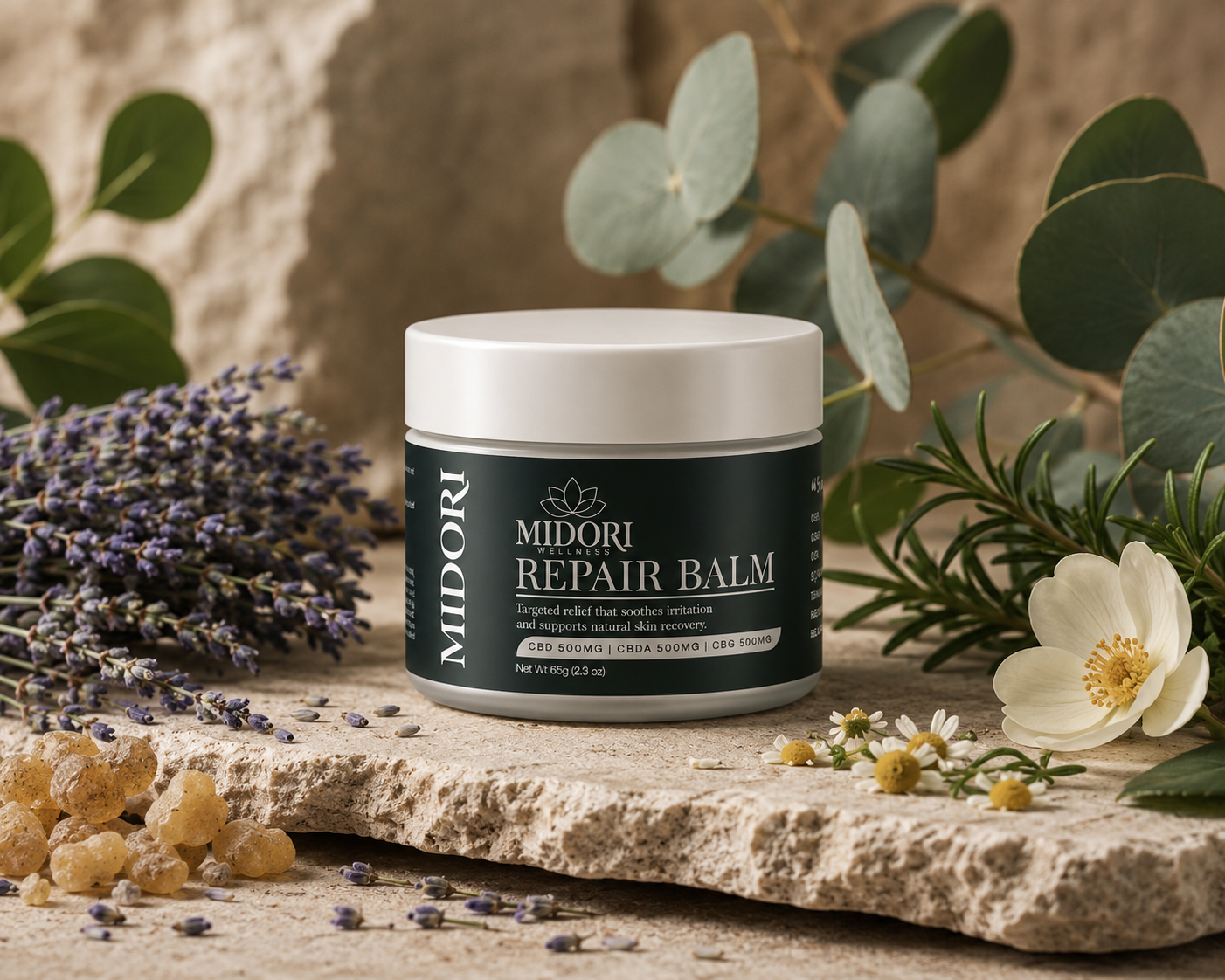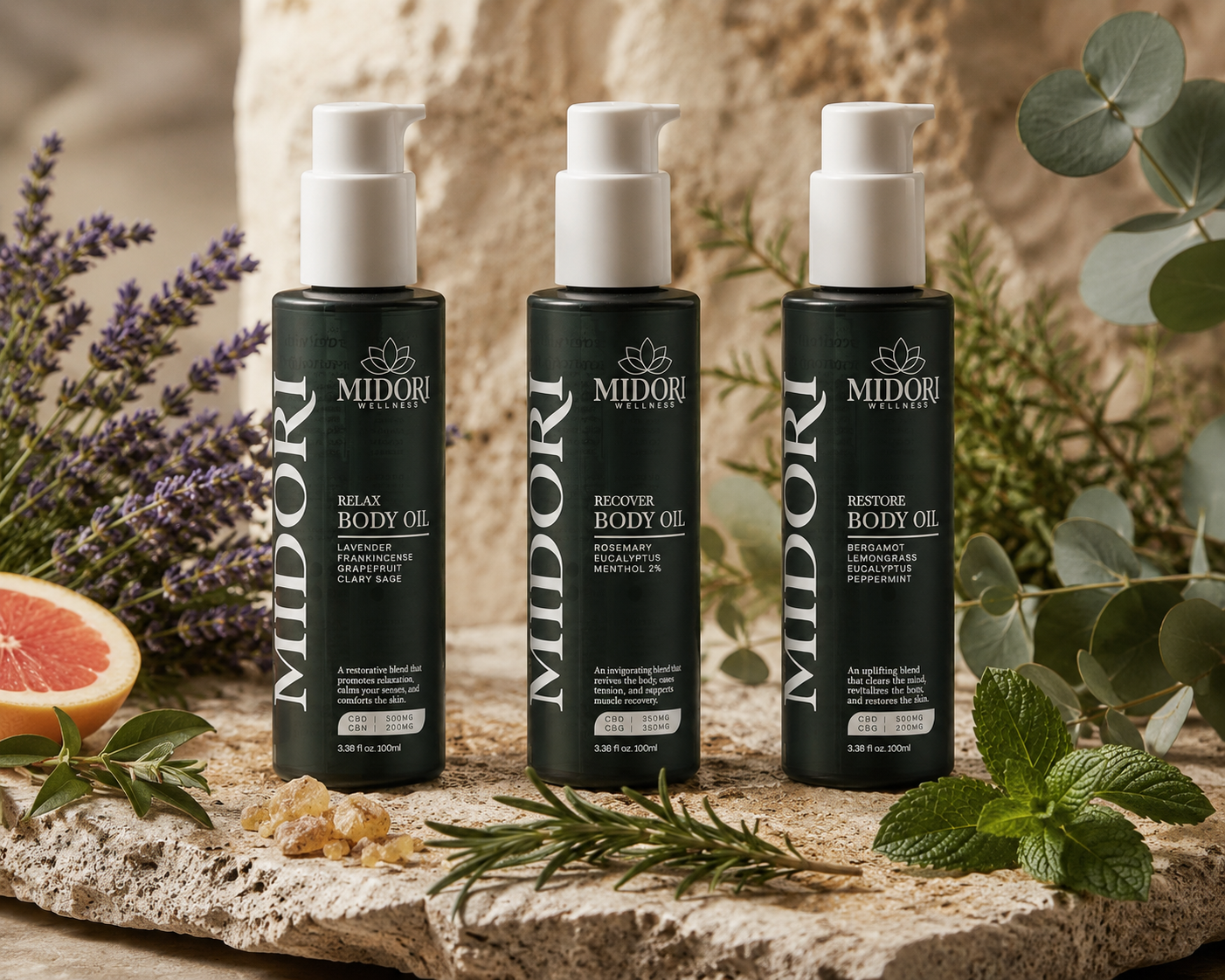
Cannabinoids in Skincare : What CBD, CBG, CBN & CBDA Actually Do
Skincare has spent decades championing isolated actives - retinol, hyaluronic acid, vitamin C, each positioned as the singular answer to a particular concern. The next chapter is less about a single molecule and more about a network. Cannabinoids in skincare represent one of the most scientifically interesting developments in cosmetic formulation right now: multiple phytocannabinoids working in concert with the skin's own receptor system, each contributing something distinct that the others cannot replicate. Discover what CBD skincare can actually do for your skin and learn how CBG, CBN, and CBDA each bring their own unique benefits to the formula.
What Are Cannabinoids in Skincare?
Before any of these ingredients make sense, one piece of biology is worth understanding: the endocannabinoid system, or ECS.
The ECS is a molecular signalling network present throughout the body and it is fully expressed in the skin. Cannabinoid receptors (CB1 and CB2), along with a wider family of secondary receptors including TRPV channels and PPARs, are distributed across epidermal keratinocytes, dermal cells, cutaneous nerve fibres, hair follicles, and sebaceous structures. The endocannabinoid system skin research makes clear that this network plays a documented role in cell growth, differentiation, and local signalling processes, including immune modulation and sensory phenomena. It is a native communication system sitting just beneath and within the surface you apply your bodycare to every day.
Research published in Pharmaceuticals (2023) describes the skin's ECS as "fully represented" in cutaneous tissue and notes that phytocannabinoids, the plant-derived cannabinoids found in hemp, can interact directly with these receptors when applied topically. This is not a marketing hypothesis; it is peer-reviewed biology that underpins an entire emerging field of dermatological research.
Phytocannabinoids do not force the skin into any particular state. They engage with a receptor network that the skin already possesses, in ways that researchers are still actively characterising. That scientific humility matters, because it is also what makes multi-cannabinoid skincare so compelling: different cannabinoids appear to engage with different aspects of this system, with different sensory profiles and different areas of early research focus.
What Does CBD Do for Your Skin?
Cannabidiol remains the most extensively studied phytocannabinoid in a skin context, and its profile is genuinely well-rounded. Understanding CBD skincare benefits starts with its antioxidant activity.
CBD is well-characterised as an antioxidant. Studies have shown it to increase expression of superoxide dismutase and glutathione peroxidase enzymes involved in cellular oxidative stress management and research in 3D human skin tissue models has demonstrated that CBD provides statistically significant protection against UVB-induced lipid peroxidation, in some cases performing comparably to vitamin C. For an ingredient that also tends to feel pleasant on skin, a soft, quickly absorbed texture that leaves skin feeling notably comfortable, that antioxidant depth is meaningful.
Topically, the sensory experience of well-formulated CBD is part of its appeal. Skin feels calmer after contact, more settled, with a smoothness that builds over continued use. Early research published in Clinical, Cosmetic and Investigational Dermatology points toward CBD's potential in skin wellness applications, though researchers consistently note that more robust clinical trials are needed to fully validate its range of effects. What the existing body of work does suggest is that the skin's ECS receptors respond to topical CBD in ways that can translate to a perceptibly more comfortable, even-toned surface appearance.
CBD also appears to contribute to synergistic effects in full-spectrum formulations. A study examining a full-spectrum Cannabis sativa extract (standardised to 5% CBD) versus CBD isolate found that the extract modulated all 26 gene targets in treated human keratinocytes, while CBD alone affected only 15 — evidence that the plant's broader complement of cannabinoids, flavonoids, and terpenes contributes something that CBD alone cannot replicate.
CBDA: The Acid Form Worth Knowing
Cannabidiolic acid is CBD's chemical precursor the form in which the cannabinoid exists before exposure to heat converts it to CBD through decarboxylation. In raw or cold-processed hemp extracts, CBDA is present in meaningful quantities, and CBDA skincare research is beginning to examine what it does distinctly from its decarboxylated form.
CBDA has a stronger affinity for certain receptor subtypes than CBD, particularly 5-HT1A serotonin receptors, which are among the receptor pathways associated with sensory calming responses. Early investigation into its topical behaviour is also encouraging from a formulation standpoint: nanoemulsion delivery systems have demonstrated significantly improved skin penetration capacity for CBDA, suggesting that with the right vehicle, CBDA's reach into the skin layers where cannabinoid receptors cluster can be meaningfully enhanced.
Experientially, CBDA brings a lighter, fresher character than CBD, a quality that suits leave-on bodycare where sensory delicacy matters. Researchers have noted that all cannabinoids including CBDA exhibit antioxidant activity, capable of scavenging free radicals and reducing metal ion activity that contributes to oxidative stress. As a newer area of active research, CBDA's full profile is still being characterised, but its distinct receptor interactions and promising absorption kinetics give it a well-earned place in a multi-cannabinoid formulation.
Is CBG Better Than CBD for Skin?
Cannabigerol is sometimes called the "mother cannabinoid" because CBGA (its acidic precursor) is the biochemical starting point from which most other cannabinoids are synthesised. What makes CBG for skin stand out is its antioxidant potency which, by at least one measure, exceeds every other cannabinoid tested.
A study comparing the antioxidant activity of seven cannabinoids — CBG, CBD, THC, CBN, CBGA, CBDA, and THCA — found that CBG demonstrated the highest free-radical scavenging capacity of the group, outperforming not only other cannabinoids but also vitamins E, A, and C. Research published in Molecules (2024) confirms that CBG surpasses vitamin C in reducing reactive oxygen species in human dermal fibroblasts — the cells responsible for producing collagen and maintaining the skin's structural matrix.
Beyond antioxidant activity, CBG has been studied for its behaviour in human keratinocytes, where it appears to modulate gene expression differently from CBD. In a 3D human skin model, gene array analysis found CBG influenced a significantly higher number of skin-related genes than CBD, including those linked to collagen, elastin, and hydration pathways. In clinical application, a single-blind study in 20 healthy volunteers found that a 0.1% CBG serum produced statistically significant improvements in transepidermal water loss and in the appearance of redness, outperforming placebo.
So is CBG better than CBD for skin? The honest answer is that they are not direct competitors. CBD vs CBG skincare comes down to different strengths: CBG leads on raw antioxidant potency and gene expression in skin models; CBD brings a longer research history and well-documented ECS receptor engagement. Formulations that include both are, by current evidence, more useful than those relying on either alone.
CBG is also notably compatible with sensitive skin. Research has confirmed no signs of irritation or cytotoxicity at concentrations relevant to cosmetic use, and it has been shown to be microbiome-friendly and active against harmful bacteria without meaningfully disrupting beneficial skin flora.
CBN: The Quiet Achiever of Evening Formulations
Cannabinol occupies a different position in the cannabinoid conversation. It is formed through the oxidative degradation of THC, which means it tends to be more abundant in aged or heated hemp extracts. It also has the most pronounced affinity for CB1 receptors of the commonly used non-psychoactive cannabinoids, giving it a distinct interaction profile within the endocannabinoid system skin network.
In sensory terms, CBN skincare is the most settled and grounding of the four cannabinoids discussed here. The experience of a CBN-rich formulation leans quiet — the kind of absorbed softness that suits an evening application ritual, when the goal is transition rather than activation. Its receptor profile aligns with pathways associated with calming sensory responses, and this character makes CBN a particularly thoughtful choice for body products designed for pre-sleep use.
Research on CBN's pharmacological properties has highlighted antioxidant activity — specifically, its capacity to scavenge reactive oxygen species and reduce oxidative stress markers — alongside interactions with both ECS receptors and non-cannabinoid receptor pathways in skin tissue. While CBN's clinical skin research is not as extensive as CBD's, its unique receptor affinity and the distinct sensory character it brings to formulation make it a meaningful inclusion in a multi-cannabinoid blend. It is not a supporting player so much as a specialist — doing something the other three cannabinoids do not do in quite the same way.
What Is the Entourage Effect in Skincare?
Each of these cannabinoids has an individual profile. The more compelling argument, though, is for what happens when they are combined, what researchers refer to as the entourage effect.
The entourage effect is a hypothesis first formalised by cannabis researchers including Dr. Ethan Russo, suggesting that the compounds in Cannabis sativa are more effective in combination than in isolation. The idea is that cannabinoids, terpenes, and flavonoids interact with each other's receptor pathways in ways that modulate, enhance, or extend their individual activities. A 2024 narrative review published in Pharmaceuticals concluded that the entourage effect "has significant implications for the medical use of cannabinoid-containing products," while also noting that "further research and evidence are needed to establish the clinical efficacy, safety, and regulatory framework". It is an established scientific hypothesis with promising preliminary evidence, not a settled claim.
What the existing research does support is the idea that combinations outperform isolates. The previously cited study comparing broad spectrum CBD skincare extracts to isolated CBD in human keratinocytes is one example. Gene array work comparing CBG and CBD in skin models is another — where the combination activated more relevant pathways than either compound alone.
For bodycare formulation, this translates to a practical principle: a product built around four cannabinoids with complementary receptor affinities, sensory characters, and research-backed antioxidant profiles is by current scientific reasoning more interesting than one built around a single cannabinoid, however well-studied. CBD's comfort, CBDA's lightness, CBG's antioxidant depth, and CBN's settling quality each contribute something distinct. Together, they address more of what the skin's own signalling network is capable of receiving.
Botanical Partners: What the Plants Bring
Multi-cannabinoid science does not exist in a vacuum. The most thoughtful formulations pair cannabinoid actives with botanicals that have their own long research and traditional use histories and ingredients whose profiles complement rather than duplicate what the cannabinoids provide.
Turmeric has been used in Ayurvedic wellness practice for centuries, and its active compound curcumin is among the most studied botanical antioxidants in contemporary research. Its warm, golden character and antioxidant credentials make it a natural companion to CBG in formulations targeting oxidative stress and the visible effects of environmental exposure.
Frankincense (boswellia) brings boswellic acids — triterpenoids that have been studied for their effects on cellular signalling pathways, including those associated with the appearance of tone and texture. Research has examined boswellic acids for their effects on local enzyme activity relevant to skin structure. Traditional resin extraction gives frankincense a grounding, resinous quality in fragrance as well as function.
Arnica, with its long heritage in post-activity herbal traditions across European folk medicine, brings a cooling, clarifying sensory quality that has made it a staple in preparations designed for use after physical exertion. Its active compounds sesquiterpene lactones including helenalin, have been the subject of topical research for decades.
Vitamin E (tocopherol) is a well-established cosmetic antioxidant, one of the most studied and broadly accepted in the regulatory lexicon. As a lipid-soluble antioxidant, it integrates naturally into the skin's own lipid matrix and works alongside CBD and CBG's antioxidant mechanisms without duplication.
Cooling botanicals — peppermint, eucalyptus, menthol — contribute a crisp, immediate sensory quality that is experientially distinct from the slower, deeper work of cannabinoids and antioxidant actives. That contrast of cooling immediacy and warm, absorbed depth is part of what makes multi-cannabinoid bodycare feel different from standard topicals — more multi-layered in the sensory experience it delivers.
How to Build a Cannabinoid Skincare Routine
The good news: using cannabinoid-rich bodycare does not require a complicated protocol. A few principles make it more effective.
Consistency matters more than quantity. The skin's ECS is a receptor network, and topical cannabinoids engage it through repeated contact over time. Daily use, even of a small amount will generally produce more noticeable results than occasional high-dose applications.
Match the formulation to the moment. CBD bodycare applied after a shower, when the skin barrier is slightly open and blood flow is elevated, tends to absorb more efficiently. CBN-dominant formulations suit evening use, when the settling, grounding sensory quality aligns with the body's natural wind-down.
Look for third-party tested products. Cannabinoid content in skincare varies significantly depending on extraction method, formulation, and quality control. Products with independently verified cannabinoid profiles are the ones where the research-based rationale actually holds.
Pair with complementary actives. Cannabinoids work well alongside vitamin C and E, niacinamide, and botanical antioxidants ingredients that support the same broad goals without competing for the same receptor pathways.
A cannabinoid skincare routine does not need to be your entire regime. It can serve as a targeted layer, a serum, a body lotion, a balm within a broader approach to skin wellness.
The Future of Bodycare Belongs to Complexity
The skincare consumer of 2025 is not easily impressed. They have read the ingredient labels, worked through the single-active era, and are asking different questions now — not "does this product have CBD?" but "what kind of cannabinoids, and why those specific ones, and what does the science actually say?"
Multi-cannabinoid skincare, paired with botanicals that have earned their place through research and tradition, is the answer to those questions. Not because the science is complete — it is not, and formulations that claim otherwise overstate the evidence — but because the science is directional, the receptor biology is real, and the sensory experience of well-made multi-cannabinoid bodycare is genuinely distinctive.
The skin has a cannabinoid system. It has had one all along. Formulations that engage it thoughtfully, with the right combination of phytocannabinoids and complementary botanicals, are not a trend. They are where intelligent bodycare has been heading for years.
Sources:
-
The Skin and Natural Cannabinoids — Topical and Transdermal Applications, Pharmaceuticals, 2023
-
Cannabigerol (CBG): A Comprehensive Review of Its Molecular Mechanisms, Molecules, 2024
-
The Entourage Effect in Cannabis Medicinal Products, Pharmaceuticals, 2024
-
Cannabinoids, CBG Defy Oxidative, Inflammatory Effects in Skin, Cosmetics & Toiletries, 2022
-
Health benefits, pharmacological properties, and metabolism of CBN, ScienceDirect
-
The Role of Topical CBD in Skin Disorders, Dermatology Advisor
Want to learn more? Take a look at our other blog posts.
The Science Behind Midori Repair Balm: Why Your Skin Deserves Better Than Basic Moisture.
Cannabinoids in Skincare : What CBD, CBG, CBN & CBDA Actually Do
Why the Best Sleep of Your Life Starts With What Happens After You Fall Asleep
The Gold Standard of Skincare Ingredients: Why Manuka Honey UMF 16+ Changes Everything
Japanese Skincare Ingredients: The Ancient Botanicals Behind Midori's Body Oil Ritual.
On The Green CBD Is Now Midori Wellness — and the Formulas Have Never Been Better
World Cup 2026 CBD Soccer Recovery
Does CBD Show Up In A Drug Test
CBG vs CBD: What's the Difference and Why You Need Both?
The Botanical Science Behind Targeted Comfort: Why Midori Wellness Relief Crème Is Built Different