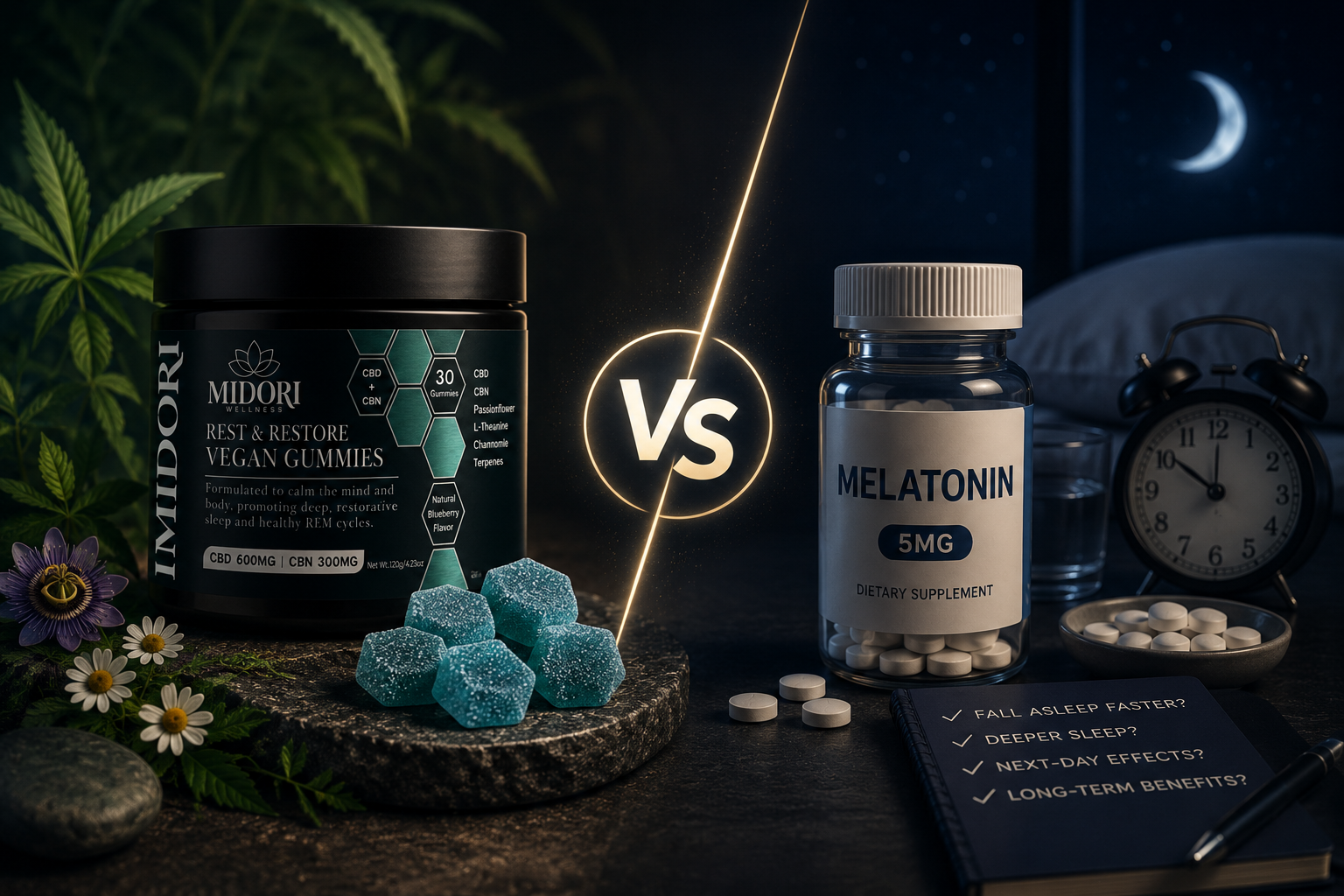
CBD for Sleep vs. Melatonin: What's the Difference and Which Actually Works?
If you've ever stood in a pharmacy aisle staring at the sleep supplement shelf, you already know how crowded the conversation around sleep has become. Melatonin is everywhere — in gummies, capsules, sprays, and even chocolate — marketed as the obvious answer to anyone who struggles to fall asleep or stay asleep. And for millions of people, it's the first thing they reach for.
But a growing number of people are finding that melatonin doesn't quite deliver what they were hoping for. They fall asleep fine and wake up groggy. Or they take it for a few weeks and notice it stops working. Or they find that even though they're sleeping, they wake up feeling like they didn't.
That's because melatonin and CBD + CBN work through fundamentally different mechanisms — and understanding that difference is the key to finding a nighttime approach that actually serves your sleep, not just your sleep onset.
This is the comparison nobody is making clearly enough. Let's change that.
What Melatonin Actually Does (And What It Doesn't)
Melatonin is a hormone produced by the pineal gland in response to darkness. As light fades in the evening, melatonin levels rise — signalling to the body that it's time to prepare for sleep. It's part of the circadian rhythm system: the biological clock that governs not just sleep but temperature regulation, hormone release, and dozens of other timed biological processes.
When you take a melatonin supplement, you're essentially sending that "it's getting dark" signal artificially. Research reviewed by Healthline confirms that melatonin works primarily by shifting sleep timing — it reduces the time it takes to fall asleep and can help recalibrate the body clock after jet lag or shift work. A 2013 meta-analysis found melatonin "decreases sleep onset latency, increases total sleep time and improves overall sleep quality" with meaningful consistency.
That's a legitimate benefit — particularly for people whose sleep problems are primarily about timing: struggling to feel sleepy at the right hour, adjusting after travel, or managing shift schedules.
But here's what melatonin doesn't do:
It doesn't address why you can't fall asleep when your body is in an activated, anxious, or wired state. It doesn't improve the architecture of your sleep — how much time you spend in deep NREM or REM stages. And it doesn't help keep you asleep if your underlying issue is nighttime awakenings rather than sleep onset.
The Side Effect Reality Nobody Puts on the Label
Melatonin is widely marketed as harmless — and at the right dose, for the right purpose, it largely is. But the gap between "largely harmless" and "what most people are actually taking" is significant, and the side effects that fall into that gap are ones that a large portion of users experience regularly.
Night terrors and vivid nightmares are among the most commonly reported complaints from melatonin users — and the mechanism is well understood. Melatonin influences REM sleep, the dream-rich stage of the sleep cycle. At higher doses, it can artificially intensify REM activity, producing more vivid, emotionally charged, and sometimes frightening dreams. Cleveland Clinic's sleep medicine team confirms this directly: "too high of a dose can lead to unpleasant side effects" including vivid dreams and nightmares, and notes that the only reliable fix is reducing the dose — which most commercial products make difficult given how oversized their doses are.
A 2017 study referenced by Cleveland Clinic found that 71% of melatonin supplements didn't contain the amount advertised on the label — with some containing fillers, preservatives, or even serotonin, which can be harmful at elevated levels. A 2023 JAMA letter reported in the Washington Post found that melatonin gummies in particular contained actual doses ranging from 17% to 478% of what the label stated — meaning a gummy labelled as 3mg might actually deliver over 14mg. For a hormone that experts recommend taking at 0.5–1mg, that's an enormous discrepancy.
Next-day grogginess — what many users describe as a "melatonin hangover" — is one of the most consistent complaints associated with higher doses. This occurs because melatonin has a half-life of 40–60 minutes but continues influencing neurological function for hours after peak concentration. At the oversized doses found in most commercial products, residual effects carry into the morning: sluggishness, cognitive fog, and difficulty fully waking that can persist well into the day. GoodRx's clinical overview lists next-day drowsiness as one of the primary dose-dependent side effects, noting it is "more likely if you take high doses of melatonin" — which, given the labelling problems above, is most of the market.
Headaches are the second most commonly documented adverse effect in clinical trials. A systematic review published in Clinical Interventions in Aging (PMC) — analysing safety data from randomised, placebo-controlled trials across thousands of patients — identified headache as one of the top reported adverse effects of melatonin use, alongside dizziness and daytime sleepiness. The same review found that trials without placebo arms consistently reported higher rates of adverse events — suggesting the real-world incidence of headaches may be meaningfully higher than what controlled trials capture.
Long-term use concerns are increasingly being raised by neurologists and sleep specialists. A 2026 NDTV health report citing neurologist Dr. Singhal warns that melatonin should be used temporarily — as a short-term corrective tool over 2–6 weeks — and discontinued once sleep has normalised. "Discontinue melatonin use if there are any adverse reactions like grogginess or fatigue, vivid dreams, or if it does not appear to be effective," Dr. Singhal advises. Yet millions of people take melatonin nightly for months or years — a pattern for which Cleveland Clinic notes "minimal research exists on using melatonin beyond a few months" and usage has "only been deemed safe for up to three months."
A 2023 review in Neurology International (PMC) adds that in older adults, extended melatonin use was associated with a 44% increased risk of bone fracture — a finding that introduces a serious consideration for the older adults who are among the most frequent melatonin users.
None of this means melatonin is dangerous for everyone. What it means is that the side effect profile is real, dose-dependent, and significantly worsened by the fact that most commercial products contain far more melatonin than clinical guidelines recommend. And it means that for the large proportion of users who experience night terrors, morning grogginess, or headaches, there is a meaningful reason to explore whether their sleep problems might be better addressed through a different mechanism entirely.
For those issues, you need something that works upstream — and that's where CBD + CBN operate.
How CBD + CBN Approach Sleep Differently
Where melatonin works on the clock, CBD and CBN work on the conditions. They don't artificially time-stamp your brain for sleep — they address the physiological and psychological states that prevent your body from reaching and sustaining quality sleep on its own.
This is a meaningful distinction. Melatonin says "it's time." CBD + CBN work to ensure that when it's time, your nervous system is actually ready.
CBD: Calming the System That Keeps You Awake
CBD (cannabidiol) interacts with the body's endocannabinoid system (ECS) — a regulatory network with documented involvement in stress response, mood, inflammation, and sleep-wake cycles. Research published in Frontiers in Pharmacology summarises CBD's properties as including anxiolytic, anti-inflammatory, analgesic, and neuroprotective effects — all of which are relevant to why people struggle to sleep.
The anxiolytic mechanism is particularly important. A 2019 retrospective study referenced across multiple clinical reviews found that 72% of patients using CBD reported improvements in both anxiety and sleep — with anxiety consistently emerging as the primary mediating factor. This makes biological sense: when the nervous system is in a state of activation — elevated cortisol, racing thoughts, physical tension — sleep architecture cannot complete itself regardless of what your melatonin levels are doing.
Research reviewed by the University of Pennsylvania's Center for Sleep and Circadian Neuroscience adds that at higher doses, CBD has a sedating effect and is associated with increased total sleep time, while also showing promise for improving REM sleep architecture — the phase responsible for cognitive recovery, emotional processing, and memory consolidation. Unlike THC, which suppresses REM sleep, CBD appears to support normal sleep architecture without disruption.
CBN: The Sleep-Specific Cannabinoid
CBN (cannabinol) is the cannabinoid that has attracted the most focused scientific attention for nighttime use — and the research emerging from clinical trials is among the most compelling in the hemp space.
The University of Sydney's Lambert Initiative published the first study using objective measures — not self-reported surveys — to demonstrate that CBN increases both REM and non-REM sleep, producing significantly increased total sleep time. The effect was described as comparable to zolpidem — a prescription sleep medication — and human clinical trials were initiated off the back of the data with "very promising results."
A double-blind, randomised, placebo-controlled trial published in Experimental and Clinical Psychopharmacology (2024) — 293 participants — found that 20mg CBN taken nightly significantly reduced nighttime awakenings and reduced overall sleep disturbance compared to placebo, with no impact on daytime functioning. No grogginess. No rebound. No dependency.
That last point matters. The question most people eventually ask about melatonin — "will I become dependent on it?" — is one where the answer for CBN is reassuringly different. The mechanisms are distinct: melatonin replaces a hormone your body produces; CBN supports the endocannabinoid system, which regulates sleep as part of a broader homeostatic function.
The Botanical Layer: L-Theanine, Chamomile & Passionflower
What makes Midori Rest & Restore CBD + CBN Sleep Gummies different from a simple CBD + CBN product is what surrounds the cannabinoids. Each vegan gummy delivers 20mg CBD + 10mg CBN — a calibrated, clinically relevant dose of both cannabinoids in a single serving — alongside a botanical complex of three ingredients that each contribute distinct, complementary mechanisms to the sleep support system.
L-Theanine is an amino acid found in green tea that promotes alpha brain wave activity — the relaxed-but-alert state associated with meditation and the natural transition into sleep. Research published in Food & Function (Royal Society of Chemistry, 2023) confirmed theanine maintains sleep quality by modulating GABA, serotonin, dopamine, and tryptophan while suppressing excitatory glutamate activity. Clinical trials found it improved sleep quality, reduced sleep onset latency, and led to participants feeling more rested upon waking — without sedation. L-Theanine doesn't force sleep; it creates the neurological conditions in which sleep arrives naturally.
Chamomile (apigenin) binds to GABA-A receptors — the same receptors targeted by benzodiazepines, but gently and without dependency risk. A 2024 systematic review in Clinical Nutrition Research analysed 10 clinical trials and found 9 of 10 concluded chamomile was effective in reducing anxiety — directly addressing one of the primary drivers of nighttime wakefulness. Sustained use over 26 weeks showed continued benefit without tolerance development.
Passionflower (Passiflora incarnata) works through similar GABA pathways. A 2024 randomised, double-blind, placebo-controlled trial published in Cureus found passionflower extract produced a statistically significant reduction in perceived stress and a significant increase in total sleep time compared to placebo. The researchers concluded it "modulates the GABA neurotransmission system and helps to improve sleep quality" — a mechanistic confirmation of what traditional herbalism has observed for centuries.
Together, these three botanicals extend the formula's reach into areas that CBD and CBN alone don't fully address — the GABA system, alpha wave induction, and sustained anxiolytic support across the night.
Head to Head: The Key Differences
Who Should Consider CBD + CBN Over Melatonin?
If your primary complaint is struggling to wind down — a mind that won't stop, physical tension that follows you to bed, or difficulty transitioning from the demands of the day into a state of rest — CBD + CBN + botanical support is addressing the root of the problem in a way melatonin simply isn't designed to.
If you wake frequently through the night and find yourself lying awake at 2am or 4am unable to return to sleep, the CBN clinical data on reducing nighttime awakenings is directly relevant. Melatonin has limited evidence in this area; CBN has a randomised controlled trial.
If you wake up groggy on melatonin — a common experience at standard commercial doses — the absence of next-day impairment in CBN trials suggests a meaningfully different morning experience.
And if you've been taking melatonin for months or years and are wondering whether it's still actually doing anything, the answer is that melatonin's evidence base is strongest for short-term use and circadian correction. The botanical and cannabinoid system that Rest & Restore is built around is designed for consistent nightly use as part of an intentional long-term sleep ritual.
Can You Take Both?
Yes — melatonin and CBD + CBN operate through different mechanisms and there are no documented interactions between them. Some people find that using melatonin for the initial timing correction (jet lag, shifting schedules) while using CBD + CBN for ongoing sleep quality support is a sensible approach. Others find that once they've established consistent sleep quality with CBD + CBN, they no longer need melatonin at all.
As with any supplement, if you're on medications or have a diagnosed sleep disorder, check with a healthcare professional before introducing new products to your routine.
The Midori Approach: Sleep as a System, Not a Signal
The philosophy behind Midori Rest & Restore CBD + CBN Sleep Gummies is that quality sleep requires more than a timing cue. It requires a nervous system that is genuinely ready to rest, an endocannabinoid system that is supporting healthy sleep architecture, and botanical support for the GABA pathways that govern the transition from alertness to deep, restorative rest.
20mg CBD + 10mg CBN, alongside L-Theanine, chamomile, and passionflower, in a clean pectin-based vegan gummy. No gelatin. No artificial colours. A naturally derived blueberry flavour that makes this a genuinely pleasant part of a nightly ritual.
Take one gummy 30–60 minutes before bed. Use consistently. The botanical and cannabinoid research shows clearly that cumulative, consistent use produces stronger, more stable results than any single-dose intervention — which is why the most important thing about a nighttime formula is one you'll actually keep reaching for.
For a deeper look at the sleep science behind every ingredient in this formula, read our full post: Why the Best Sleep of Your Life Starts With What Happens After You Fall Asleep.
These statements have not been evaluated by the Food and Drug Administration. This product is not intended to diagnose, treat, cure, or prevent any disease. If you have a diagnosed sleep disorder or are taking medications, consult a healthcare professional before use.
Shop Rest & Restore CBD + CBN Sleep Gummies →
Sources
-
Melatonin Gummies May Have a Higher Dose Than What's on the Label — Washington Post / JAMA
-
Current Insights into the Risks of Using Melatonin — PMC / Clinical Interventions in Aging
-
Chronic Use of Melatonin Can Be Harmful, Warns Neurologist — NDTV
-
Potential Role of Cannabidiol on Sports Recovery — PMC / Frontiers in Physiology
-
Cannabis, Cannabinoids, and Sleep: A Review — University of Pennsylvania CBTI
-
Cannabinol Increases Sleep: First Objective Measure Study — University of Sydney Lambert Initiative
-
Theanine Maintains Sleep Quality in Healthy Subjects — Royal Society of Chemistry / Food & Function
-
The Effect of Oral Chamomile on Anxiety: A Systematic Review — Clinical Nutrition Research
-
Randomized, Double-Blind, Placebo-Controlled Clinical Trial of Passionflower — PMC / Cureus
Want to learn more? Take a look at our other blog posts.
The Science Behind Midori Repair Balm: Why Your Skin Deserves Better Than Basic Moisture.
Cannabinoids in Skincare : What CBD, CBG, CBN & CBDA Actually Do
Why the Best Sleep of Your Life Starts With What Happens After You Fall Asleep
The Gold Standard of Skincare Ingredients: Why Manuka Honey UMF 16+ Changes Everything
Japanese Skincare Ingredients: The Ancient Botanicals Behind Midori's Body Oil Ritual.
On The Green CBD Is Now Midori Wellness — and the Formulas Have Never Been Better
World Cup 2026 CBD Soccer Recovery
Does CBD Show Up In A Drug Test
CBG vs CBD: What's the Difference and Why You Need Both?
The Botanical Science Behind Targeted Comfort: Why Midori Wellness Relief Crème Is Built Different