The Gold Standard of Skincare Ingredients: Why Manuka Honey UMF 16+ Changes Everything
There are ingredients that appear on a label to check a box, and then there are ingredients that fundamentally change what a formula can do. Manuka honey is firmly in the second category — and it's the ingredient we built the Midori CBD + CBG Body Crème around.
This isn't a post about honey as a general wellness trend. It's about understanding what makes manuka honey scientifically distinct from every other honey on earth, why the grading system matters enormously, where it actually comes from, and why the bees that produce it are unlike any other bees in the world. By the time you've read this, you'll understand exactly why UMF 16+ is a meaningful specification — not a marketing number — and why it matters in your skincare routine.
Where Manuka Honey Comes From
To understand manuka honey, you first have to understand the plant.
Leptospermum scoparium — known in New Zealand as the manuka bush — is a flowering shrub native to the remote, untouched wilderness of New Zealand and parts of southeastern Australia. It grows in the kinds of places most people never reach: rugged hillsides, windswept coastal cliffs, river valleys, and regenerating forest margins where other plants struggle to establish. It's a pioneer species — one of the first plants to colonize disturbed ground after fire or erosion — and it thrives precisely where conditions are harsh.
The manuka bush flowers for only two to six weeks per year. That brevity is part of what makes manuka honey so rare. Beekeepers have an extraordinarily narrow window to position their hives and harvest what the bees collect during the bloom. When the flowers close, the season is over — no second chances, no extension. The honey that results from this short, intense flowering window is among the most carefully managed and rigorously tested food products in the world.
New Zealand has long claimed manuka honey as its own — and for good reason. While Leptospermum scoparium does grow in parts of Australia, New Zealand's government has established strict scientific authentication standards through the Ministry for Primary Industries (MPI) to define and protect genuine manuka honey. The UMF trademark itself is exclusively for honey produced, tested, and packed in New Zealand.
The Bees Behind the Honey
The European honeybee (Apis mellifera) is the primary producer of manuka honey in New Zealand — brought to the country by European settlers in the 19th century. But it's the environment these bees work in, not the bees themselves, that makes the honey extraordinary.
Manuka honey is harvested from some of the most remote locations on earth. Many beekeepers guard their hive locations fiercely — the land, the altitude, the plant density, and the absence of agricultural contamination all affect the quality of the final honey. Hives are often transported by helicopter into mountain terrain, positioned during the brief bloom window, and retrieved once the flowers close.
The bees collect nectar specifically from manuka flowers, where an unusually high concentration of dihydroxyacetone (DHA) is present. DHA is the raw compound that converts into methylglyoxal (MGO) during the ripening process inside the hive — and MGO is the compound responsible for manuka honey's remarkable bioactive properties. According to Medical News Today, manuka honey contains up to 100 times the concentration of MGO found in conventional honey. No other honey comes close.
Once the honey is ready — when roughly 80% of the honeycomb cells have been sealed with beeswax and moisture content drops below 18% — it's harvested, rigorously tested, and only then graded and certified.
Decoding the Grading System: UMF vs. MGO
Walk into any premium wellness store and you'll see manuka honey labeled with either a UMF number, an MGO number, or both. Understanding the difference is essential to knowing what you're actually buying.
MGO (Methylglyoxal)
MGO is the naturally occurring compound responsible for manuka honey's potent antibacterial activity. The MGO number on a label tells you how many milligrams of methylglyoxal are present per kilogram of honey. Comvita, one of the world's leading manuka producers, explains it simply: more MGO means stronger antibacterial activity.
MGO ratings typically range from around 83 (entry-level) to 1200+ (ultra-premium).
UMF (Unique Mānuka Factor)
UMF is a more comprehensive system — and the one we consider the gold standard. Developed and maintained by the Unique Manuka Factor Honey Association (UMFHA), UMF doesn't just measure MGO. It tests for four distinct markers:
-
MGO (Methylglyoxal) — antibacterial potency
-
Leptosperin — a compound found only in genuine mānuka flower nectar, confirming authenticity
-
DHA (Dihydroxyacetone) — confirms the honey's shelf life and future MGO development potential
-
HMF (Hydroxymethylfurfural) — ensures freshness and confirms the honey hasn't been overheated or improperly stored
No other grading system tests all four. MGO alone tells you one piece of the story. UMF tells you the whole story: potency, purity, authenticity, and freshness — independently verified, not self-reported.
The UMF Scale
According to Aotea Health, UMF 15–20 is the range most commonly used in skin therapy applications. That's precisely the specification in Midori's Body Crème — UMF 16+, placing it squarely within the skin therapy grade range. This isn't an arbitrary number selected for label appeal. It's a meaningful threshold.
What Manuka Honey Actually Does for Skin
There are three primary mechanisms through which mānuka honey benefits the skin — and together they make it one of the most multi-functional ingredients in serious skincare.
1. Humectant Hydration
Manuka honey is a natural humectant, meaning it actively draws moisture from the surrounding environment into the skin and holds it there. Australia's Manuka Honey describes this as nourishing the skin "without it feeling heavy or oily" — a quality that makes it exceptional in a rich body formula that still needs to absorb without residue.
A comprehensive review of honey in dermatology published in PubMed confirms that in cosmetic formulations, honey "exerts emollient, humectant, soothing, and hair conditioning effects, keeps the skin juvenile and retards wrinkle formation, regulates pH and prevents pathogen infections." This is the foundation on which the Midori Body Crème is built — manuka honey as the anchor, not a trace ingredient.
2. Antioxidant Protection
Manuka honey contains an exceptional concentration of phenolic compounds and flavonoids — including pinobanksin, pinocembrin, and chrysin — that research published in the journal Foods identifies as potent free-radical scavengers. Free radicals are the primary driver of oxidative stress in skin, which over time degrades collagen, accelerates visible aging, and disrupts the skin barrier.
Manuka honey's antioxidant capacity is notably higher than that of conventional honey varieties — and that concentration is what gives UMF-grade manuka its particular value in a skincare context.
3. Skin Comfort and Barrier Support
The MGO, flavonoids, and phenolic compounds in manuka honey also support the skin's natural environment in a way that helps it look and feel more comfortable. WebMD notes manuka honey's long-standing use in skin conditioning, including for dry and sensitive skin. Its naturally low pH (3.5–4.5) is also closely aligned with the skin's own ideal surface pH — supporting a balanced, healthy-looking complexion over time.
The amino acids present in manuka honey further support a smooth surface appearance, working alongside its humectant properties to leave skin visibly softer and more supple with consistent use.
Why UMF 16+ in a Body Crème Is Significant
Using UMF 16+ honey in a topical formula is a meaningful formulation decision. Lower-grade honey — UMF 5 or below — is essentially table-grade: suitable as food, but without the concentrated bioactive profile that makes high-grade manuka compelling in skincare. UMF 16+ sits in the skin therapy range, bringing real MGO concentration alongside the full suite of authenticated bioactive compounds.
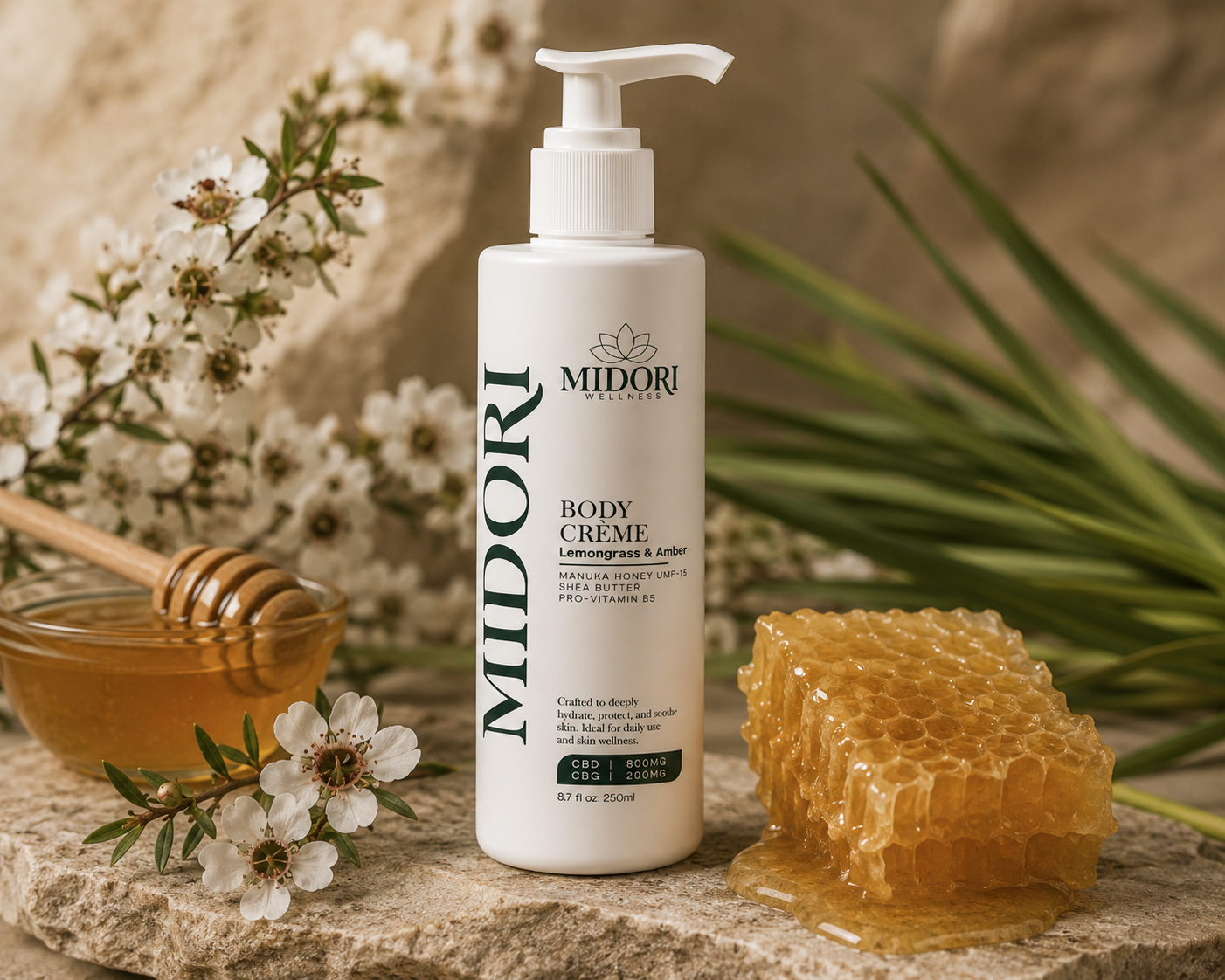
In the Midori CBD + CBG Body Crème, this UMF 16+ manuka honey works in tandem with a nourishing complex of shea butter, jojoba oil, and panthenol (Pro-Vitamin B5) — a combination that addresses hydration at multiple levels. Shea delivers rich, immediate softness. Jojoba's composition mirrors the skin's own natural sebum for seamless absorption. Panthenol attracts and holds water in the deeper layers of the skin. And manuka honey ties the entire moisture system together, drawing hydration to the surface and keeping it there.
CBD and CBG round out the formula — 800mg CBD and 200mg CBG — adding a botanical conditioning dimension that elevates this beyond a standard moisturizer. The result is a silky, fast-absorbing crème that delivers real performance from first use: immediate softness, lasting nourishment, and skin that looks and feels genuinely replenished.
How to Use Midori Body Crème for Best Results
Apply generously to clean, dry skin immediately after showering or bathing — this is when the skin is most receptive to moisture, and applying before the skin fully dries helps lock hydration in more effectively. Massage until fully absorbed.
For best results, use daily. The skin-conditioning effects of manuka honey, shea butter, and cannabinoids build with consistent use — meaning the longer you use it, the softer and more resilient your skin looks and feels.
The warm amber and lemongrass scent makes this a genuinely pleasant part of any daily routine — grounding, understated, and clean.
Shop the Midori CBD + CBG Body Crème →
The Bottom Line
Manuka honey is one of the most studied, most authenticated, and most rigorously graded natural ingredients in skincare. Understanding the UMF system — and why UMF 16+ represents a meaningful quality threshold — puts you in a position to make genuinely informed choices about what goes on your skin.
We chose UMF 16+ because it's the grade that delivers real bioactive presence in a topical formula. Paired with CBD, CBG, shea, jojoba, and panthenol, it forms the foundation of a body crème built for skin that deserves more than surface-level care.
Explore the full Midori Wellness collection →
Sources
-
The Difference Between MGO & UMF Mānuka Honey — Aotea Health
-
How to Choose UMF Grading for Mānuka Honey — Taylor Pass Honey
-
Manuka Honey: Medicinal Uses, Benefits, and Side Effects — WebMD
-
The Composition and Biological Activity of Honey — PMC / Foods
-
7 Benefits of Manuka Honey for Skin — Australia's Manuka Honey
-
Harvesting Mānuka Honey from Top Secret Locations — Mountain Valley Honey
-
Manuka Honey — What Is It and What Is It Good For? — Down to Earth
-
From Hive to Jar: How We Harvest Mānuka Honey — Primal By Nature
Want to learn more? Take a look at our other blog posts.
The Science Behind Midori Repair Balm: Why Your Skin Deserves Better Than Basic Moisture.
Cannabinoids in Skincare : What CBD, CBG, CBN & CBDA Actually Do
Why the Best Sleep of Your Life Starts With What Happens After You Fall Asleep
The Gold Standard of Skincare Ingredients: Why Manuka Honey UMF 16+ Changes Everything
Japanese Skincare Ingredients: The Ancient Botanicals Behind Midori's Body Oil Ritual.
On The Green CBD Is Now Midori Wellness — and the Formulas Have Never Been Better
World Cup 2026 CBD Soccer Recovery
Does CBD Show Up In A Drug Test
CBG vs CBD: What's the Difference and Why You Need Both?
The Botanical Science Behind Targeted Comfort: Why Midori Wellness Relief Crème Is Built Different