Japanese Skincare Ingredients: The Ancient Botanicals Behind Midori's Body Oil Ritual.
There is a reason Japanese skincare has commanded global attention for centuries. Long before the language of "actives" and "bioavailability" entered the beauty conversation, Japanese culture had already developed a sophisticated, philosophy-driven approach to caring for skin — one built on deep observation, botanical knowledge, and an acute understanding of what the body actually needs. At the heart of that tradition are a handful of ingredients that have remained unchanged for over a thousand years: the golden oil pressed from tsubaki seeds on the island of Oshima, the milky bran left behind when rice is milled, and squalane — a lipid so structurally close to human sebum that the skin barely registers it as foreign.
These are not trend ingredients. They are foundations — and they form the carrier base of every Midori Wellness body oil.
The Philosophy That Shapes the Formula: Mottainai, Kanso, and Wabi-Sabi
Before examining the chemistry, it is worth understanding the cultural framework that shapes how Japanese skincare ingredients are selected and used. Japanese aesthetic philosophy is not merely decorative — it is a way of relating to materials, to the body, and to the natural world.
Mottainai (もったいない) is a deeply embedded ethic of using everything fully. On Oshima Island, where tsubaki has been cultivated since the Heian period (794–1185 AD), the entire camellia seed is used: the oil extracted for beauty and food, the remaining seed cake repurposed as a natural cleanser and fertiliser, the wood burned for heat. This ethos of completeness aligns naturally with the multi-functional nature of botanical oils — a single ingredient that moisturises, protects, and prepares the skin in one gesture.
Kanso (簡素) — simplicity, the elimination of the non-essential — is the reason that Japanese beauty rituals have historically favoured fewer, higher-quality ingredients over layered complexity. A geisha's skincare cabinet in the Edo period might have contained tsubaki oil, water, and little else. The philosophy pushes toward the essential: what does this skin actually need, and which ingredient delivers it most purely?
Wabi-sabi (侘び寂び) is the acceptance of imperfection and transience — the beauty found in natural forms. In skincare, it translates to a preference for ingredients as they exist in nature rather than synthetic approximations. Rice bran oil carries the specific character of the rice variety and region from which it was milled. Tsubaki oil pressed from wild-harvested Oshima seeds has a depth that refined versions lack. These natural variations are not flaws — they are expressions of the ingredient's origin.
Midori (緑), the Japanese word for green, carries this philosophy in its name. The brand is not borrowing Japanese aesthetics as a surface flourish — it signals a genuine philosophical alignment that what grows from the earth, treated with precision and respect, delivers something no laboratory can fully replicate.
Tsubaki: The Camellia Oil That Built a Beauty Culture
Of all Japanese skincare ingredients, tsubaki oil — pressed from the seeds of Camellia japonica — carries perhaps the longest and most storied tradition. Its documented use as a beauty ingredient dates to the Heian period, but it was during the Edo period (1603–1868) that tsubaki moved from regional practice to cultural institution.
The story of how it became so embedded begins on Oshima Island, a volcanic island roughly 120 kilometres south of Tokyo. The women of Oshima — who harvested camellia seeds as part of their livelihood — demonstrated its transformative effect on skin and hair. Their complexions were noted for their clarity, their hair for an extraordinary lacquered shine that became, in time, the standard of beauty for the country. Tokyo Islands' documentation of Oshima tsubaki production records that this exchange economy — seeds for oil — persisted for generations and shaped the island's entire agricultural identity.
Geishas adopted tsubaki oil during the Edo period with particular intent. Their profession demanded immaculate skin capable of bearing heavy white oshiroi makeup over long working nights, then being completely removed without damage. Tsubaki oil served both functions: as a preparatory skin treatment before makeup application, and as a gentle cleansing oil at the end of the night. KYOMI Skin's historical documentation describes how geishas also worked tsubaki through their hair before dressing their elaborate hairstyles, imparting the glossy lacquer effect that became a defining aesthetic of the era.
The reason tsubaki earned such trust is written in its chemistry. The oil is exceptionally high in oleic acid (omega-9), typically accounting for more than 80% of its fatty acid composition — with Toshima Island Camellia producers citing figures as high as 86% for seeds grown in their volcanic soil. Oleic acid is the dominant fatty acid in human sebum. This structural similarity means tsubaki absorbs with an immediacy the skin recognises — drawing it in without greasiness. An oil that penetrates rapidly delivers its actives, including cannabinoids, where they can work.
It also contains vitamins A, D, and E, polyphenol antioxidants, and a naturally occurring trace of squalene. This compound profile means that beyond its carrier function, tsubaki is actively contributing to the condition of the skin it passes through.
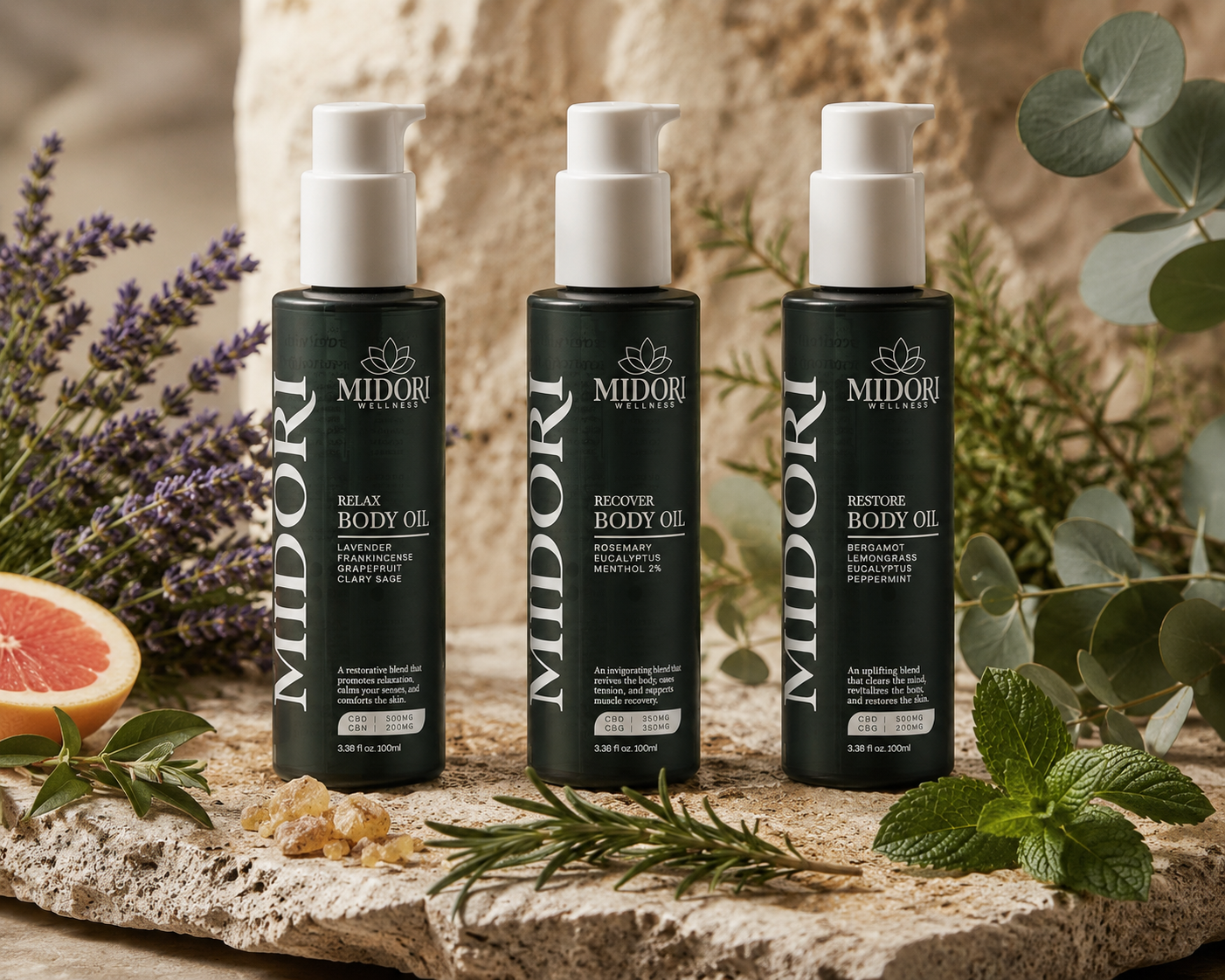
All three Midori body oils — Body Oil Recover, Body Oil Relax, and Body Oil Restore — use tsubaki as their foundational carrier. The choice reflects an understanding that the oil carrying the cannabinoids determines how efficiently those cannabinoids reach the skin, and tsubaki, with its sebum-mimicking oleic acid profile and centuries of demonstrated skin compatibility, is among the most logical choices available.
Rice Bran Oil and the Legend of the Nukazuka Bijin
In the Edo period, travellers passing through Japan's rice-milling regions reported a consistent observation: the women who worked in the rice mills, whose hands were in constant contact with the bran produced when white rice was polished from its hull, had skin of exceptional softness and luminosity. This observation gave rise to the term nukazuka bijin — "rice bran beauties" — a phrase that acknowledged what centuries of empirical contact had demonstrated long before anyone could explain the chemistry.
The nukazuka bijin tradition is accurate observation later confirmed by analysis. Rice bran — the thin outer layer stripped from brown rice to produce white — is among the most nutrient-dense byproducts of any food crop. The oil extracted from it contains gamma-oryzanol, a molecule found almost exclusively in rice and its derivatives. Research published in PubMed identifies gamma-oryzanol as a natural antioxidant used in Japan in both foods and cosmetics, and Cipher Skincare's ingredient documentation notes it has been shown to support sebaceous gland function and skin hydration.
Rice bran oil also contains ferulic acid — a powerful plant-based antioxidant that works synergistically with vitamin E — alongside tocopherols, tocotrienols, ceramides, and phytosterols. ScienceDirect research on ferulic acid and gamma-oryzanol confirms the synergistic antioxidant activity of these compounds. Dermalogica's analysis of rice bran extract highlights linoleic acid and squalene lipids within rice bran that strengthen the moisture barrier and support the skin's ability to retain hydration.
The texture of rice bran oil sits at an interesting point between richness and lightness — substantial enough to leave skin feeling conditioned, yet light enough to absorb without heaviness. This makes it an ideal complement to tsubaki in a body oil formula: tsubaki penetrates rapidly and delivers oleic-acid richness deep into the skin's structure; rice bran provides a broader spectrum of antioxidant and barrier compounds at the surface.
Midori includes rice bran oil in all three body oils and in the Body Scrub — Amber & Lemongrass. The logic of including rice bran in the scrub is deliberate: exfoliation increases skin permeability by removing the accumulated layer of dead cells. Applying rice bran oil as part of that step means its conditioning compounds reach fresher, more receptive skin — the exfoliation step is never stripping, it reveals and nourishes together.
Squalane: The Olive-Derived Gold Standard of Carrier Oils
Squalane has a long and complicated history in cosmetics — one that makes Midori's choice of source particularly meaningful. It was a Japanese biochemist, Mitsumaru Tsujimoto, who first isolated squalene from shark liver oil in 1906, identifying a hydrocarbon that would become one of the most studied compounds in dermatology. For much of the twentieth century, shark-derived squalane dominated the global market — particularly in Japan, which held approximately 40% of global supply in the early 2000s.
The ethical problems with that sourcing prompted a decisive industry shift. Today, olive-derived squalane — extracted from the unsaponifiable fraction of olive oil — is the gold standard, and the version used in every Midori body oil formula. It is chemically identical to its predecessor in cosmetic function, but sourced entirely from plants, fully vegan, and ecologically sound. The hydrogenation process that converts olive squalene into stable squalane produces an ingredient with a comedogenicity rating of zero, tolerated by every skin type, and leaving no greasy residue. Sophim's historical analysis of squalane documents the full arc of this transition from animal-derived to plant-derived sourcing.
What makes olive-derived squalane exceptional from a formulation standpoint is how it integrates into the skin. Westlake Dermatology's analysis explains the mechanism: squalane integrates into the stratum corneum's lipid matrix — the layer of ceramides, fatty acids, and cholesterol that seals the skin's outer cells — rather than simply sitting on the surface. By filling the intercellular gaps, it slows transepidermal water loss from within, meaning the skin retains its own moisture more effectively.
Boldpurity Skincare's research adds a dimension particularly relevant to a cannabinoid body oil: an ex vivo skin study confirmed that adding 5% squalane to a formulation significantly increased the skin retention time of other active compounds. For a body oil delivering precise levels of CBD, CBG, or CBN, squalane's presence directly supports the time those actives spend in contact with the skin. PMC research published in Molecules further documents squalane's biological activity and role in supporting skin absorption of topical compounds.
The choice of olive-derived squalane in Midori's formulas reflects the same values that run through the entire product line: botanical sourcing, vegan credentials, and ingredient decisions made with both efficacy and ethics in mind.
How Japanese Botanicals Interact with Cannabinoids in a Body Oil
The question of why carrier oil quality matters for topical cannabinoid delivery is one that formulators have given considerable thought. CBD, CBG, and CBN are fat-soluble compounds — they require a lipid medium both to remain stable in formulation and to reach the skin's lipid-rich structures where they can exert their effects.
The stratum corneum, which squalane integrates into so readily, is itself a lipid-rich environment. Oleic acid — the dominant fatty acid in tsubaki — is known in pharmaceutical research to act as a skin penetration enhancer. Its similarity to sebum means it is absorbed through the same pathways the skin uses to process its own lipids, and compounds dissolved in it travel along the same routes. Research into percutaneous absorption of cannabidiol has examined how different vehicle formulations affect CBD's ability to penetrate human skin, and ScienceDirect work on CBD skin penetration confirms that carrier choice meaningfully affects the rate and extent of penetration.
The Midori formulation approach takes a notably precise position on cannabinoid delivery. The Broad Spectrum used across the body oils is built from individual isolates — not a pre-made broad-spectrum extract — meaning the CBD, CBG, and CBN content is engineered to exact levels. This precision only makes sense alongside carrier oils of equivalent quality: a carefully measured 500mg of CBD in a carrier that inhibits absorption is a different product than the same 500mg in a carrier that actively supports it.
Three Distinct Sensory Experiences: The Body Oil Range
The three Midori body oils share a Japanese botanical carrier base but each resolves into a distinctly different sensory world, shaped by its essential oil profile and cannabinoid composition.
Body Oil Recover combines CBD (350mg) and CBG (350mg) with rosemary, eucalyptus, and menthol. The essential oil profile is deliberately sharp and invigorating — rosemary camphoraceous and stimulating, eucalyptus cool and penetrating, menthol providing its characteristic cooling sensation. The effect is clarifying rather than calming. Applied to warm, recently active skin, the carrier oils absorb with particular speed, and the cooling notes cut through with clean precision.
Body Oil Relax layers CBD (500mg) and CBN (200mg) with lavender, clary sage, frankincense, and grapefruit. This is the most complex aromatic profile in the range. Lavender and clary sage are deeply familiar in a calming context. Frankincense adds a resinous, slightly woody depth that prevents the formula from being merely floral. Grapefruit provides a citrus lift that stops the blend from becoming too soporific. The presence of CBN makes Relax specifically suited to the slow, deliberate self-care ritual before sleep. The skin feels immediately softer while the aromatic experience asks the mind to slow down in parallel.
Body Oil Restore pairs CBD (500mg) and CBG (200mg) with bergamot, lemongrass, peppermint, and eucalyptus. Where Recover is sharp and Relax is soft, Restore is bright — citrus-forward and clarifying in a way that feels like orientation rather than stimulation. Bergamot carries both freshness and a slight floral-green depth. Lemongrass adds a green grassiness that sits well against the cooler peppermint and eucalyptus. This formula has the quality of the morning — of beginning something, of skin being prepared for the day ahead.
The Body Scrub: Exfoliation as the First Step
The Midori Body Scrub — Amber & Lemongrass deserves attention not just as a standalone product but for what it makes possible in the skin ritual sequence. Exfoliation is, in its most practical sense, the act of increasing skin permeability. By removing the accumulated layer of corneocytes, it exposes a fresher surface layer with less impedance to topical actives.
The Body Scrub combines camellia oil, rice bran, and a CBD + CBG complex in an amber and lemongrass aromatic frame. The inclusion of camellia oil and rice bran in the scrub itself is deliberate: even as the scrub removes the outermost dead cell layer, it is simultaneously conditioning the skin newly exposed beneath it. The exfoliation step is never stripping — it reveals and nourishes in the same gesture.
Used before a Midori body oil, the scrub functions as a primer — removing the barrier between the oil and the skin's more receptive layers, so that the tsubaki, rice bran, and olive-derived squalane carry the cannabinoids into a surface that has been genuinely prepared to receive them.
Ritual vs. Routine: Katachi and the Mindful Application
There is a Japanese concept called katachi (形) — often translated as "form" — that extends beyond aesthetics into the idea that the shape of an action, its deliberateness and care, is itself meaningful. In traditional Japanese tea ceremony, katachi describes the precise, purposeful sequence of movements that transforms the simple act of making tea into something with presence and weight.
Applied to a skincare ritual, this concept makes a practical argument for slowing down. A body oil applied hastily delivers something. But a body oil applied with deliberate pressure, warming the oil between the hands before contact, attending to each area with care — delivers something more. The skin absorbs readily when warmed. Massage increases local circulation. The aromatic compounds in the essential oils are experienced more fully when the application itself is slow.
Midori's body oils are designed to be experienced. The distinct sensory profiles — Recover's invigorating sharpness, Relax's soft floral depth, Restore's citrus-forward brightness — reward attention. Applied slowly, the full aromatic complexity becomes apparent: first the top notes (the bright, volatile elements like peppermint and grapefruit), then the mid notes (lavender, lemongrass, rosemary), and finally the base (frankincense, amber, the warm dry-down of the carrier oils themselves).
This is the katachi of a body oil ritual — not a chore to complete before dressing, but a form of practice. The quality of Japanese skincare ingredients deserves application that honours their depth.
FAQ: Japanese Skincare Ingredients and CBD Body Oil
What are the key Japanese skincare ingredients in Midori's body oils?
Midori's body oils are built on three Japanese botanical ingredients: tsubaki (camellia japonica) oil, rice bran oil, and olive-derived squalane. Together, these form the carrier base that delivers CBD, CBG, and CBN into the skin. Tsubaki is the primary carrier, valued for its high oleic acid content and centuries of use in Japanese beauty; rice bran adds antioxidant compounds including gamma-oryzanol; squalane integrates into the skin's lipid matrix to support moisture retention and extend active ingredient contact time.
What are the tsubaki oil benefits for skin?
Tsubaki oil absorbs readily into skin due to its oleic acid profile — typically exceeding 80% — which mirrors the composition of human sebum. Skin feels noticeably softer and more supple after application, leaving a silky finish rather than a greasy residue. It also contains vitamins A, D, and E alongside polyphenol antioxidants, and has been central to the Japanese beauty routine since the Heian period.
How does rice bran oil benefit skin, and what is the nukazuka bijin tradition?
Rice bran oil contains gamma-oryzanol — found almost exclusively in rice and its derivatives — alongside ferulic acid, tocopherols, ceramides, and phytosterols. The nukazuka bijin ("rice bran beauties") tradition describes women who worked in Japanese rice mills during the Edo period and were noted for their exceptionally soft, luminous skin, attributed to regular contact with rice bran. Research suggests gamma-oryzanol supports skin hydration and barrier function, while ferulic acid works synergistically with vitamin E as an antioxidant.
What are the squalane skincare benefits, and why is it olive-derived?
Squalane is a stabilised form of squalene — a lipid that makes up approximately 13% of human sebum. When applied topically, it integrates into the stratum corneum's lipid matrix, helping reduce transepidermal water loss and leaving skin feeling smooth and comfortable. Midori uses exclusively olive-derived squalane — chemically identical in function to earlier animal-derived versions, but fully vegan, plant-sourced, and ecologically sound. Studies also suggest squalane increases the skin retention time of other active ingredients, supporting the cannabinoids in the formula.
What is the difference between the Midori body oils, and which is right for me?
The three body oils share a Japanese botanical carrier base but differ in their essential oil profiles and cannabinoid blends. Body Oil Recover (CBD 350mg + CBG 350mg) has a sharp, invigorating character with rosemary, eucalyptus, and menthol — suited to active routines. Body Oil Relax (CBD 500mg + CBN 200mg) is soft and floral with lavender, clary sage, frankincense, and grapefruit — oriented toward evening wind-down. Body Oil Restore (CBD 500mg + CBG 200mg) is bright and citrus-forward with bergamot, lemongrass, peppermint, and eucalyptus — suited to morning preparation.
Is Japanese botanical skincare suitable for all skin types?
The botanical oils at the heart of Japanese beauty routines — tsubaki, rice bran, and olive-derived squalane — are each noted for their compatibility with a wide range of skin types. Tsubaki's sebum-mimicking profile means it absorbs quickly without contributing to congestion. Rice bran oil is considered hypoallergenic in topical use and suitable for sensitive skin, according to Dermalogica's ingredient research. Squalane has a comedogenicity rating of zero, making it appropriate even for oily or breakout-prone skin.
Sources
-
Oshima Island Tsubaki Oil Production History — Tokyo Islands
-
From Geisha Traditions to Modern Skincare: The Power of Tsubaki Oil — KYOMI Skin
-
Tsubaki: An Ancient Japanese Beauty Secret — Five Elements Natural Skincare
-
Camellia Cultivation and Cold-Pressing — Oshima Tsubaki Hair Care
-
Gamma-Oryzanol as a Natural Antioxidant in Japanese Cosmetics — PubMed
-
Ferulic Acid and Gamma-Oryzanol Antioxidant Activity — ScienceDirect
-
70 Years of Squalane History: From Animal to Plant-Derived — Sophim
-
Squalane and Stratum Corneum Integration — Westlake Dermatology
-
Squalane as Carrier and Skin Retention Enhancer — Boldpurity Skincare
-
Biological Activities of Squalene/Squalane and Skin Absorption — PMC / Molecules
-
Skin Permeability of Cannabidiol — PMC / Medical Cannabis and Cannabinoids
-
In Vitro CBD Skin Penetration and Carrier Oil Effects — ScienceDirect
Want to learn more? Take a look at our other blog posts.
The Science Behind Midori Repair Balm: Why Your Skin Deserves Better Than Basic Moisture.
Cannabinoids in Skincare : What CBD, CBG, CBN & CBDA Actually Do
Why the Best Sleep of Your Life Starts With What Happens After You Fall Asleep
The Gold Standard of Skincare Ingredients: Why Manuka Honey UMF 16+ Changes Everything
Japanese Skincare Ingredients: The Ancient Botanicals Behind Midori's Body Oil Ritual.
On The Green CBD Is Now Midori Wellness — and the Formulas Have Never Been Better
World Cup 2026 CBD Soccer Recovery
Does CBD Show Up In A Drug Test
CBG vs CBD: What's the Difference and Why You Need Both?
The Botanical Science Behind Targeted Comfort: Why Midori Wellness Relief Crème Is Built Different